

Few topics in pet care spark as much heat as feeding a cat without meat. For dogs, the science is relatively reassuring — they are omnivores. For cats, the conversation is genuinely different, and it would be dishonest to pretend otherwise. Cats are obligate carnivores: their bodies are built around nutrients that occur naturally only in animal tissue. That single fact shapes everything that follows.
This guide takes a balanced but candid approach. We will not dismiss plant-based feeding out of hand — the emerging research is more nuanced than the loudest voices on either side suggest — but we will be clear-eyed about the real biological constraints, the nutrients a cat simply cannot go without, and what doing this responsibly actually requires. If you are even considering a vegetarian or vegan diet for your cat, this is what you need to know before you change a single meal.
Key takeaways
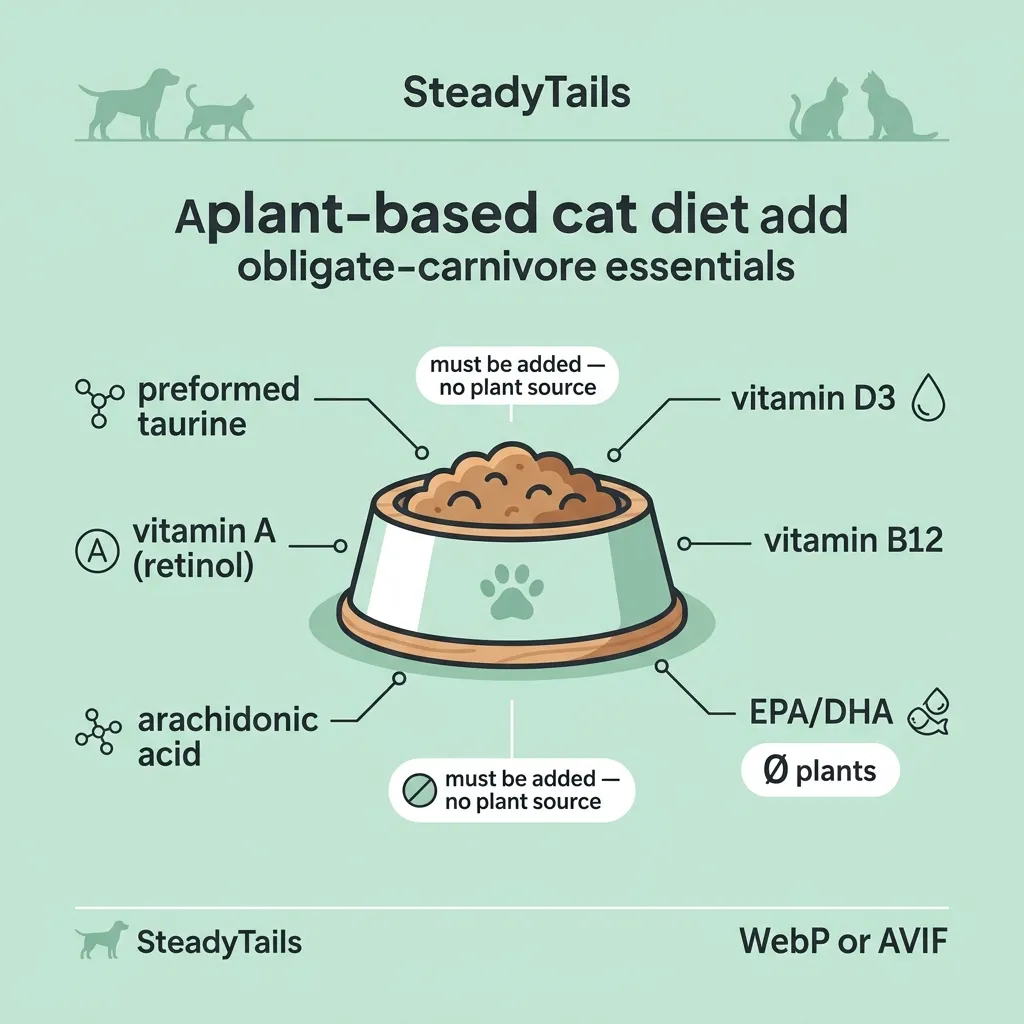
- Cats are obligate carnivores with hard requirements for preformed taurine, vitamin A (retinol), arachidonic acid, and vitamin D3 — nutrients plants don't provide.
- Mainstream veterinary bodies urge caution. The British Veterinary Association and others generally advise against meat-free cat diets without careful oversight.⁷
- The evidence is genuinely mixed, not settled. Some studies found deficient diets,⁴⁵ while surveys of cats on sound diets found no higher illness rates¹ and largely normal blood taurine.²³
- Feline deficiencies are fast and can be permanent — taurine deficiency can cause irreversible blindness and heart failure.
- If you proceed, the rules are strict: a complete-and-balanced commercial diet, veterinary supervision, and periodic blood monitoring — never a home-made or unsupplemented diet.
Critical Nutrient Scorecard for Vegetarian & Vegan Cats
Cats are obligate carnivores. Their bodies lack the enzymes to synthesize these vital nutrients from plants.
Taurine
Obligate requirement. Essential for heart function and eyesight. Deficiency causes blindness and dilated cardiomyopathy.
Arachidonic Acid
Essential fatty acid. Cats lack the delta-6 desaturase enzyme to synthesize it from plant oils.
Active Vitamin A
Cats cannot convert beta-carotene (from carrots/plants) into active Vitamin A (retinol). Must be pre-formed.
Vitamin B12
Required for neurological integrity and blood cells. Found exclusively in animal tissues.
Why are cats different from dogs (and from us)?
The whole debate hinges on one word: obligate. Dogs and humans are flexible omnivores who can manufacture certain nutrients from dietary building blocks. Cats evolved as strict hunters, and over time their bodies stopped making several nutrients they could reliably get from prey. The result is a set of hard dietary requirements:
- Taurine. Dogs can synthesize taurine from other amino acids; cats largely cannot, so they need preformed taurine in the diet. It is concentrated in muscle and organ meat — and is destroyed somewhat by cooking, which is why even meat-based cat foods are routinely supplemented with it.⁸
- Preformed vitamin A (retinol). Humans and dogs convert plant beta-carotene into vitamin A. Cats can't do this efficiently, so they require retinol, which is found in animal tissue or must be supplied synthetically.⁸
- Arachidonic acid. This essential omega-6 fatty acid occurs in animal fat. Cats cannot make enough of it from plant oils, so it must be added.⁸
- Vitamin D3. Cats cannot make vitamin D in their skin from sunlight the way we do, and they use the D3 form less interchangeably than dogs — so a reliable dietary source matters.
- Arginine and high protein. Cats use protein for energy continuously and depend on arginine to process protein waste; their overall protein needs run higher than a dog's.
None of this means the nutrients are impossible to supply without meat — synthetic taurine, algal DHA, and supplemental retinol all exist. It means the margin for error is much smaller than for dogs, and that is the honest heart of the matter.
What does the research actually show?
It would be easy to cherry-pick studies to "prove" either side. Here is the balanced version.
The reasons for caution are real
- Veterinary bodies advise against it. As of its position statements, the British Veterinary Association has stated that cats are obligate carnivores and should not be fed vegetarian or vegan diets, citing concerns about nutrient bioavailability and interactions.⁷
- Taurine can crash quickly. In one controlled study, cats' plasma taurine fell by roughly 87% within just two weeks on a vegetarian diet, and was undetectable by six weeks.³
- Some commercial and home diets have failed. Analyses of vegan and vegetarian cat foods have found products that did not meet minimum nutrient recommendations, and two vegan cat diets evaluated in 2004 were both found nutritionally inadequate.⁴⁵
But the picture is not one-sided
- Long-term feeding looked mostly fine in practice. In a study of cats kept on vegetarian or vegan diets for at least a year, blood cobalamin (B12) was normal in all cats tested and taurine was within range in about 82% of them — with no critical deficiencies reported.²
- A large guardian survey found no greater illness. Knight and colleagues surveyed over 1,300 cats and reported that, after adjusting for age and other factors, cats on plant-based diets were not more likely to suffer common health problems — and on some owner-reported indicators they fared slightly better.¹
- The deficiency studies often used deficient diets. A systematic review concluded that the evidence for harm in cats on nutritionally sound vegan diets is limited, while emphasizing the small number of studies and modest sample sizes.³
The honest synthesis: the danger in the cautionary studies came overwhelmingly from diets that were not properly formulated, not from "plants" as such. That is reassuring and sobering at once — it means a complete diet can work, but it also means a poorly formulated one fails fast, and a cat pays the price more quickly than a dog would.
Vegetarian vs. vegan: what's the difference for cats?
The distinction matters even more for cats than for dogs:
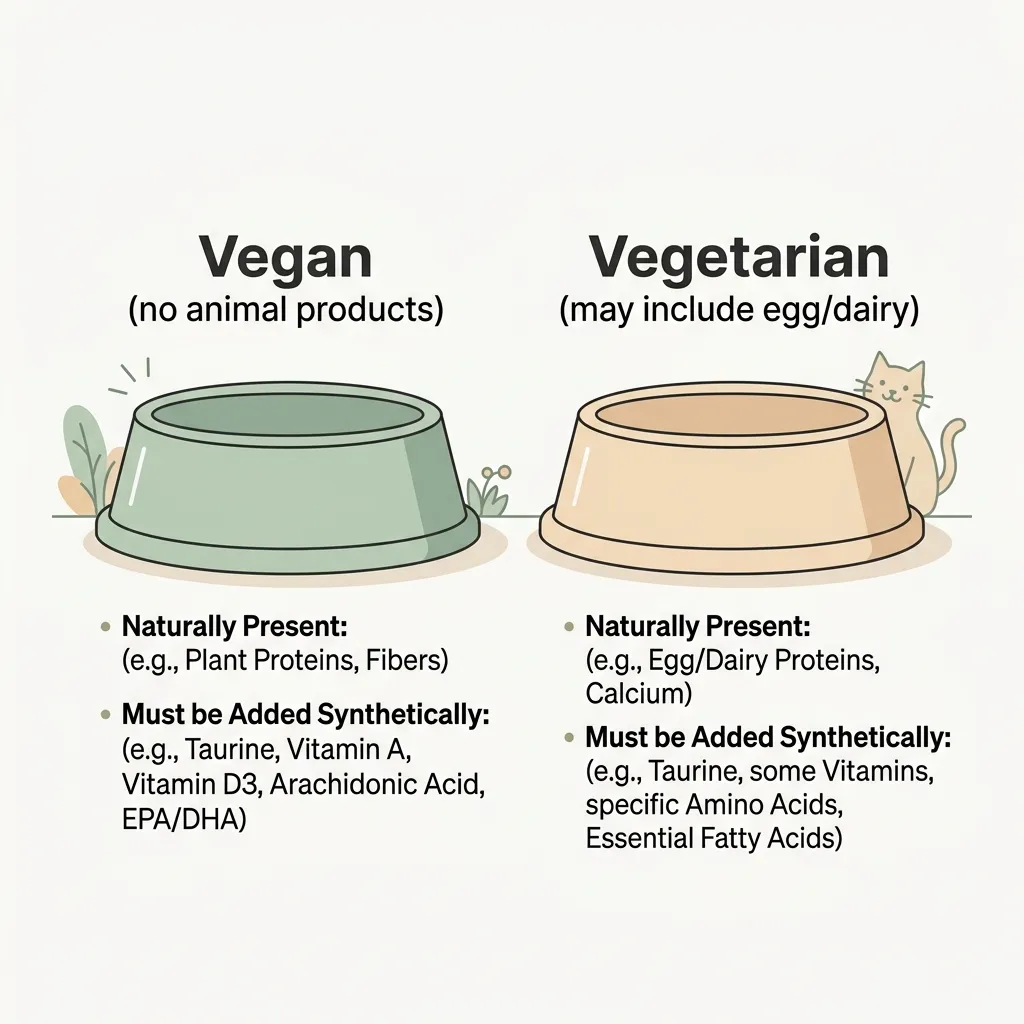
- Vegetarian diets can include eggs and dairy, which actually contain some preformed taurine, vitamin B12, and retinol — making a vegetarian diet meaningfully easier to balance for a cat than a fully vegan one.
- Vegan diets contain no animal products at all, so every obligate-carnivore nutrient must come from a synthetic supplement or algae. This is achievable in a professionally formulated commercial food, but it is the least forgiving option and the one that most demands veterinary oversight.
Which nutrients can cats not go without?
This is the core of responsible decision-making. Several of these nutrients have no meaningful plant source at all and must be added to any meat-free cat diet. A genuinely complete commercial food does exactly that — here is what to look for and why each one matters.⁸
| Nutrient | Why a cat must have it | Source in a plant-based diet |
|---|---|---|
| Taurine (preformed) | Heart and eye health. Cats can't synthesize enough; deficiency causes blindness and DCM. | Synthetic (fermentation-derived) taurine — no usable plant source. |
| Arachidonic acid | Essential omega-6 for skin, immunity, and reproduction; cats can't make it from plant oils. | Synthetic arachidonic acid or algal sources — not in plants. |
| Vitamin A (retinol) | Vision, immunity, skin. Cats can't convert plant beta-carotene into retinol. | Supplemental preformed retinol — plants only supply beta-carotene. |
| Vitamin D3 | Calcium balance and bone health; cats can't make it from sunlight. | Supplemental D3 (cats use it more reliably than plant-derived D2). |
| Vitamin B12 (cobalamin) | Nerve function and red blood cells; essentially absent from plants. | Fermentation-derived B12; eggs/dairy in vegetarian diets. |
| Niacin (B3) | Cats have a high niacin requirement and limited ability to make it from tryptophan. | Supplemental niacin. |
| EPA & DHA (omega-3) | Anti-inflammatory fats for skin, joints, brain and heart. | Algal oil (vegan EPA/DHA); flax ALA is converted poorly. |
| Arginine & high-quality protein | Continuous protein metabolism; arginine prevents ammonia build-up. | Concentrated plant proteins (soy, pea) plus supplemental amino acids. |
| Methionine, cysteine, lysine | Sulfur amino acids (taurine precursors) and lysine, often lower in plants. | Supplemental DL-methionine, taurine, and legume proteins. |
| Iron, zinc, iodine | Blood, immune, skin, and thyroid health; less bioavailable from plants. | Mineral premixes; iodine from supplemental/sea-vegetable sources. |
The taurine stakes: blindness and heart failure
If there is one nutrient that defines this whole subject, it is taurine. Because cats cannot manufacture it in adequate amounts, a taurine-deficient diet has consequences that are both serious and, in the case of the eyes, often irreversible:
- Central retinal degeneration — progressive damage to the retina that can lead to permanent blindness.
- Taurine-deficiency dilated cardiomyopathy (DCM) — a weakening and enlargement of the heart that can be life-threatening, though it may improve with early taurine supplementation.
Here is the balancing reassurance: this is precisely the risk that a properly formulated diet is engineered to eliminate. Complete commercial vegan cat foods add synthetic taurine to meet or exceed AAFCO and FEDIAF requirements, and because synthetic taurine is produced under controlled conditions, its level can actually be more consistent than the variable taurine content of cooked meat. The takeaway is not "plants cause blindness" — it is "taurine deficiency causes blindness, so the diet must guarantee taurine, and you should verify it with blood testing."
Important medical disclaimer: SteadyTails is a tracking and coordination tool, not a source of veterinary or nutritional advice. Cats have unique obligate-carnivore requirements, and the risks of an inadequate diet are serious and can be permanent. Do not start, stop, or change your cat's diet or supplements without guidance from your veterinarian — especially for kittens, pregnant or nursing cats, and cats with any health condition.
If you try it, how do you do it safely?
If, after talking with your veterinarian, you decide to explore a meat-free diet for your cat, the quality of execution is everything. This is a short, non-negotiable checklist:
- Use a complete-and-balanced commercial diet only. Look for an AAFCO (US) or FEDIAF (EU) statement for your cat's life stage. Never attempt a home-made vegan cat diet without a complete, veterinarian-designed nutrient premix — this is where cats get hurt.
- Insist on professional formulation. Favor foods designed by qualified nutritionists that explicitly add taurine, arachidonic acid, preformed vitamin A, vitamin D3, B12, and algal DHA/EPA.
- Get baseline and follow-up blood work. Ask your vet to check blood taurine and B12 before the switch and periodically afterward — this is the single best safeguard against a silent deficiency.
- Watch urinary health. Plant-forward diets can shift urine pH; ask your vet about monitoring for feline lower urinary tract issues, and ensure plentiful water and, ideally, some wet food.
- Transition slowly and never starve a cat onto new food. Cats can develop a dangerous liver condition (hepatic lipidosis) if they stop eating. Mix foods gradually over 1–2 weeks, and stop if your cat refuses to eat.
Popular plant-based and vegetarian cat food brands
Far fewer complete vegan cat foods exist than dog foods, and commercial vegetarian (egg/dairy) cat foods are scarcer still. Below is a neutral, non-ranked overview of the most established options to orient your own research with your vet. This is not an endorsement; formulas and availability change, so always verify the current AAFCO/FEDIAF statement on the label.
| Brand | Type | Notable points |
|---|---|---|
| Ami Cat | Vegan (kibble) | Italian-made, formulated by veterinary nutritionists with added taurine; one of the longest-standing complete vegan cat foods. |
| Benevo | Vegan (kibble & wet) | UK-made since 2005, formulated to AAFCO and FEDIAF guidelines with added non-animal taurine, spirulina, and prebiotics. |
| Evolution Diet | Vegan (kibble & wet) | Long-running US/Canada brand offering taurine-enriched plant-based cat formulas. |
| Wild Earth (vegan wet) | Vegan (wet pâté) | US brand; plant-based wet cat food formulated to exceed AAFCO standards with added taurine and marine microalgae. |
| Vegetarian (egg/dairy) | Scarce commercially | Few complete commercial vegetarian cat foods exist; some owners use vegetarian recipes — these still require complete, vet-verified formulation. |
| Veterinary homemade premixes | Supplement system | Products like VegeCat / Compassion Circle aim to complete home-prepared plant-based cat meals — use only under direct veterinary supervision. |
Cat Diet Comparison: Obligate Carnivore vs. Plant-Based
| Feature | Meat-Based (Standard) | Plant-Based (Experimental) |
|---|---|---|
| Taurine & Vitamin A | Naturally abundant in active, bioavailable forms. | Must be synthetically manufactured and added; high risk of deficiency. |
| Urine pH & Kidney Health | Naturally acidic (~6.0-6.5), preventing struvite crystals. | Tends to be alkaline, leading to life-threatening urinary crystals. |
| Consensus & Evidence | Universally recommended by all veterinary associations. | Strongly discouraged by vets; highly dangerous without strict monitoring. |
A high-stakes diet change deserves close tracking
For cats, a meat-free transition is not something to "set and forget." SteadyTails lets every caregiver log meals, supplements, weight, appetite, and litter-box and energy changes on one shared timeline — so subtle shifts are caught early and your vet gets a clear record. Join the waitlist for early access on iOS and Android.
Join the SteadyTails waitlist →Why is tracking the transition doubly important for cats?
Because feline deficiencies can develop quickly and quietly, monitoring is not optional — it is part of doing this responsibly. Alongside your vet's blood-test schedule, keep a close daily record of:
- Appetite and how much is actually eaten — a cat that goes off its food needs prompt attention, never a wait-and-see.
- Body weight and condition — early warning of inadequate protein or calories.
- Litter-box and urinary habits — straining, frequency, or accidents can flag urinary problems associated with diet shifts.
- Energy, behavior, and vision — bumping into things, hesitancy in low light, or lethargy warrant an immediate vet call.
- Coat and skin condition — a barometer of fatty-acid and protein adequacy.
This kind of longitudinal record turns vague impressions into a clear, vet-ready history. If you share your cat's care across a household, one shared log also ensures everyone feeds the same food and supplements — the same coordination principle behind our companion guide to plant-based diets for dogs. For broader supplement guidance, see the top cat supplement trends for 2026: fact or myth, and for cats with existing conditions, what to log for a cat with chronic kidney disease and managing hyperthyroidism with methimazole. When your next appointment comes, our vet visit preparation checklist shows how to put that history to work.
The bottom line
Feeding a cat without meat is not the same proposition as it is for a dog, and pretending otherwise does cat owners a disservice. Cats are obligate carnivores, the mainstream veterinary stance is cautious for good reasons, and the consequences of getting it wrong — taurine-related blindness and heart disease — are severe and sometimes permanent. At the same time, the research is more nuanced than absolute prohibitions suggest: cats fed genuinely complete, well-formulated plant-based diets have generally maintained normal blood values and health in the studies done so far.
So the responsible answer is neither "never" nor "no problem." It is: only with a complete-and-balanced commercial diet, only with your veterinarian's involvement, and only with ongoing blood monitoring. If you can commit to all three, a meat-free diet for a cat moves from reckless to carefully managed. If you can't, it isn't worth the risk — and that honesty is part of caring well.
Catch the small changes before they become big ones
Log meals, supplements, weight, and daily wellness with every caregiver on the same page, and export a clean, vet-ready history for your next appointment. SteadyTails is coming soon to iOS and Android — reserve your spot free.
Get early access →References
- Knight A, Bauer A. Vegan versus meat-based cat food: Guardian-reported health outcomes in 1,369 cats, after controlling for feline demographic factors. PLOS ONE, 2023;18(4):e0284132. journals.plos.org/plosone/article?id=10.1371/journal.pone.0284132
- Wakefield LA, Shofer FS, Michel KE. Evaluation of cats fed vegetarian diets and attitudes of their caregivers. JAVMA, 2006;229(1):70–73. pubmed.ncbi.nlm.nih.gov/16817716
- Domínguez-Oliva A, Mota-Rojas D, Semendric I, Whittaker AL. The Impact of Vegan Diets on Indicators of Health in Dogs and Cats: A Systematic Review. Veterinary Sciences, 2023;10(1):52. pmc.ncbi.nlm.nih.gov/articles/PMC9860667
- Gray CM, Sellon RK, Freeman LM. Nutritional adequacy of two vegan diets for cats. JAVMA, 2004;225(11):1670–1675. pubmed.ncbi.nlm.nih.gov/15626215
- Zafalon RVA, Risolia LW, Vendramini THA, et al. Nutritional inadequacies in commercial vegan foods for dogs and cats. PLOS ONE, 2020;15(1):e0227046. pmc.ncbi.nlm.nih.gov/articles/PMC6968870
- Dodd SAS, Adolphe JL, Verbrugghe A, et al. Plant-based (vegan) diets for pets: owner characteristics and feeding practices / nutritional adequacy. PLOS ONE, 2019–2021. journals.plos.org/plosone
- British Veterinary Association (BVA). Position on feeding pets vegetarian and vegan diets — cats as obligate carnivores. bva.co.uk
- VCA Animal Hospitals / Cornell Feline Health Center. Feeding your cat & obligate-carnivore nutrient requirements (taurine, vitamin A, arachidonic acid, arginine). vcahospitals.com
- U.S. Food & Drug Administration. Taurine deficiency and diet-associated dilated cardiomyopathy (DCM): background and Q&A. fda.gov