

Cats are quietly the harder pet to supplement. They hide illness on instinct, they refuse anything that smells wrong, and they suffer from a few conditions — kidney disease, herpesvirus, stress-driven cystitis — that send owners straight to the supplement aisle looking for help. In 2026 that aisle is bigger and louder than ever, promising calmer cats, younger kidneys, and herpes "cures" in a tasty paste.
So we did for cats what we did for dogs: went to the peer-reviewed feline literature and graded the five biggest cat-supplement trends of 2026 — lysine, omega-3s, probiotics, calming chews, and joint supplements — as Fact, Myth, or somewhere in between. One of these is the best-evidenced supplement you can give a cat. Another is something a major systematic review says you should stop giving. Here's how to tell them apart.
Key takeaways: the 2026 cat scorecard
- Omega-3 fish oil — ✅ FACT. Best-evidenced cat supplement; standout role in chronic kidney disease.¹²
- Probiotics (SF68 / FortiFlora) — 🟡 EMERGING FACT. Real benefit for diarrhea and post-antibiotic gut recovery — strain-specific.³⁴
- L-lysine for herpesvirus — ❌ MYTH. A systematic review found it ineffective — and possibly counterproductive.⁵
- Calming chews (alpha-casozepine) — 🟡 PROMISING. Placebo-controlled trials show a real but modest anti-anxiety effect.⁶
- Joint supplements — ⚠️ MOSTLY MYTH ALONE. Glucosamine alone is weak; EPA/DHA + green-lipped mussel combos do better.⁷
| Supplement | 2026 verdict | Evidence strength | Key source |
|---|---|---|---|
| Omega-3 fish oil (EPA/DHA) | ✅ Fact | Strong — standout role in chronic kidney disease | ACVN nutrition notes; Vet Record 2005 |
| Probiotics (SF68 / FortiFlora) | 🟡 Emerging fact | Moderate — diarrhea and post-antibiotic recovery, strain-specific | JVIM 2011; JFMS 2026 |
| L-lysine (herpesvirus) | ❌ Myth | Ineffective — a systematic review recommends stopping it | BMC Vet Research 2015 |
| Calming chews (alpha-casozepine) | 🟡 Promising | Modest but real; placebo-controlled trials | J Vet Behavior 2007 |
| Joint supplements (glucosamine alone) | ⚠️ Mostly myth alone | Weak alone; better combined with EPA/DHA + green-lipped mussel | Vet Partner; JVIM 2010 |
First, the thing nobody tells you: cat supplements aren't regulated like medicine
Before grading a single product, you need this context, because it changes how you read every label. In the United States, cat supplements are not approved by the FDA the way prescription drugs are. No one verifies, before a product reaches the shelf, that the jar contains what the label claims, in the amount claimed, free of contaminants. Independent testing has repeatedly turned up supplements — human and animal — with far more or far less active ingredient than advertised.
That doesn't make supplements useless. It means the brand matters as much as the ingredient. Your best single filter is the National Animal Supplement Council (NASC) Quality Seal,⁸ which requires participating companies to meet quality-control and adverse-event-reporting standards. Add brands that publish third-party lab results, and you've removed most of the junk before you even weigh the science. Full buyer's checklist at the end.
Important medical disclaimer: SteadyTails is a tracking and coordination tool, not a veterinary service. This article summarizes published research for general education only — it is not veterinary advice, diagnosis, or a dosing recommendation. Supplements can interact with medications and conditions, and cats are uniquely sensitive to some compounds. Always talk to your veterinarian before starting, stopping, or changing anything you give your cat.
1. Omega-3 fish oil — ✅ Fact
The trend: Omega-3s (the marine fatty acids EPA and DHA, from fish or krill oil) are pitched for glossy coats, joints, brain aging, and kidney support. For cats, the kidney angle is the one that matters most.
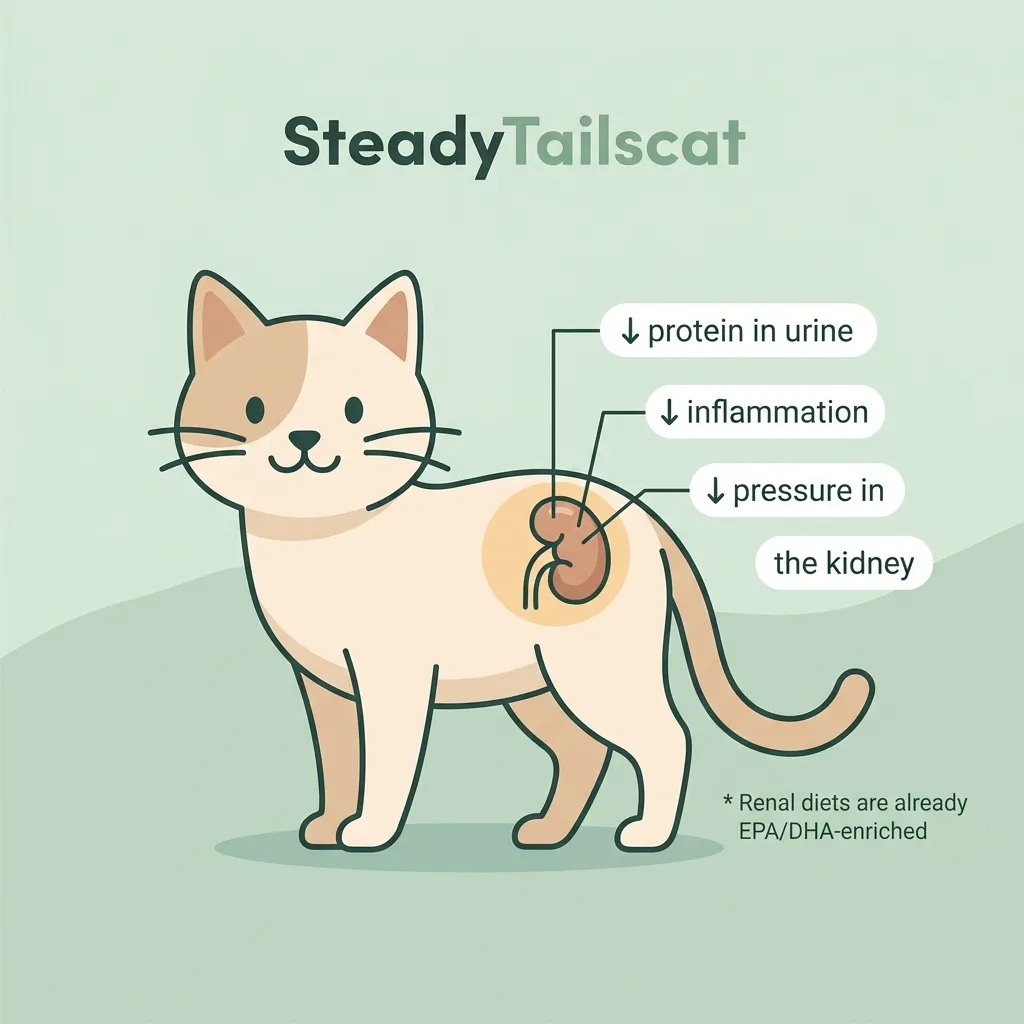
What the science says: This is the cat supplement with the strongest evidence, and its standout role is in chronic kidney disease (CKD) — one of the most common conditions in senior cats. EPA and DHA can reduce protein loss in the urine (proteinuria), lower pressure inside the kidney, and dampen inflammation in kidney tissue, all of which may slow CKD progression.¹ A frequently cited retrospective found that cats fed a renal diet with a higher EPA content lived longer than cats on other kidney diets — which is exactly why prescription renal diets come pre-enriched with omega-3s.² Omega-3s also contribute to feline joint and skin health.
The catch: Dose and form. Cats can't efficiently make EPA and DHA themselves, so they must come from the diet — but if your cat already eats a therapeutic renal diet, extra fish oil is often unnecessary and can overshoot. This is a conversation to have with your vet, who can confirm whether supplementation adds anything on top of the food. Start any fish oil slowly; loose stool is the most common side effect.
Verdict: ✅ Fact. The best-evidenced supplement on this list, and genuinely valuable for kidney and joint health — but coordinate it with your cat's overall diet and vet rather than stacking it blindly. If you're managing feline CKD, our guide on what to log for a cat with chronic kidney disease shows exactly which markers to track.
Cat Kidneys & Hydration
Cats are descended from desert animals and have a low thirst drive. They get most of their water from food.
Contains ~70-80% water. Dramatically increases urine volume and dilutes toxins.
Multiple bowls or recirculating fountains stimulate drinking and prevent dehydration.
2. Probiotics & postbiotics — 🟡 Emerging fact
The trend: Gut health is as hot for cats as it is for dogs, and 2026's twist is postbiotics — beneficial compounds produced by bacteria, marketed as a shelf-stable alternative to live cultures.
What the science says: This is a real field with genuinely encouraging — if situation-specific — feline evidence, and one strain stands out: Enterococcus faecium/lactis SF68 (sold as FortiFlora). In a randomized trial of shelter cats, the proportion with diarrhea lasting two or more days was significantly lower in the probiotic group (7.4%) than in the placebo group (20.7%).³ Newer work shows SF68 can speed the gut's recovery after a course of antibiotics, and related studies found cats on SF68 maintained microbiome diversity under stress and had fewer flare-ups of chronic herpesvirus signs over time.⁴
The catch: Benefits are strain- and situation-specific — "probiotics" is a category, not one product, and a strain proven for diarrhea won't necessarily help a healthy cat's coat or mood. Quality control is critical too: a probiotic only works if the organisms are actually alive in the numbers claimed, which (again) is why the NASC seal and third-party testing matter. The feline evidence base, while real, is still relatively small.
Verdict: 🟡 Emerging fact. Legitimately useful for the right cat and the right problem — especially diarrhea, stress, and post-antibiotic recovery — but not a daily cure-all. Match the strain to the goal.
3. L-lysine for feline herpesvirus — ❌ Myth
The trend: Feline herpesvirus 1 (FHV-1) causes the sneezing, runny eyes, and recurring upper-respiratory flare-ups that so many cats live with. For two decades, L-lysine — given as a paste, treat, or powder — has been the go-to supplement, recommended by an estimated 90%+ of cat hospitals. It feels like settled wisdom.
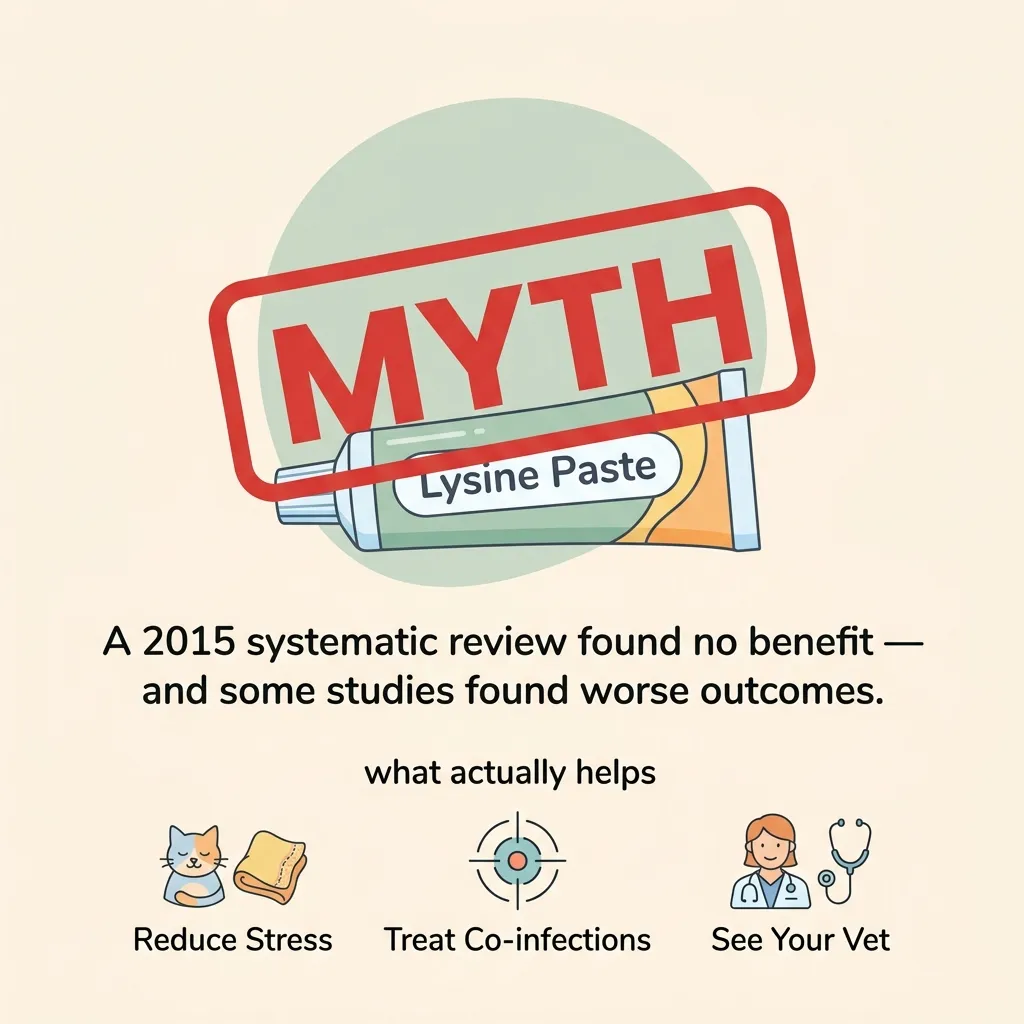
What the science says: It isn't. A 2015 systematic review in BMC Veterinary Research examined the full body of evidence and reached a blunt conclusion: lysine does not work. In the lab, it had no effect on how the virus replicates. In controlled studies in cats, it failed to prevent or treat FHV-1 infection — and, strikingly, some studies found cats given lysine had more frequent or more severe disease. The authors recommended an immediate stop to lysine supplementation given the complete lack of evidence for benefit.⁵
Why it persists: The original theory — that lysine starves the virus of the amino acid arginine it needs — sounded plausible and was adopted widely before good trials existed. It's a textbook case of a "therapeutic zombie": an idea that keeps walking long after the evidence has died. It's not dangerous in the way a toxin is, but giving it can delay the things that do help an FHV-1 cat — stress reduction, good nutrition, managing co-infections, and veterinary care during flare-ups.
Verdict: ❌ Myth. The clearest "stop doing this" on the list. If your cat has herpesvirus, skip the lysine and talk to your vet about what actually reduces flare-ups — including stress management, since stress is a major trigger.
Myth-Buster: L-lysine for Feline Herpesvirus
For years, L-lysine has been the default supplement recommended for cats suffering from Feline Herpesvirus (FHV-1) flare-ups. The theory was that it lowers arginine levels, stopping virus replication.
4. Calming & anti-anxiety supplements — 🟡 Promising
The trend: Stress is central to feline health — it drives the painful condition feline idiopathic cystitis (FIC), fuels litter-box problems, and turns vet visits into trauma. So calming supplements built around alpha-casozepine (a milk-derived protein, sold as Zylkene) and L-theanine (an amino acid from green tea) are booming.
What the science says: Unlike lysine, this category has real supporting data. A randomized, double-blind, placebo-controlled multicentre trial found alpha-casozepine reduced anxiety in cats facing socially stressful situations — they were more willing to seek contact with people and showed fewer fearful behaviors and stress signs.⁶ Additional placebo-controlled work has looked at alpha-casozepine for the stress of veterinary visits. L-theanine has supportive evidence too, though the specifically feline data is thinner. These are generally safe and well tolerated.
The catch: The effect is modest, not magic. Calming supplements work best as one part of a plan — alongside environmental enrichment, predictable routines, safe hiding spots, and pheromone diffusers — rather than as a standalone fix. Serious anxiety, aggression, or compulsive behavior deserves a proper veterinary or veterinary-behaviorist work-up, not just a chew.
Verdict: 🟡 Promising. A reasonable, evidence-supported, low-risk thing to try for situational stress like vet visits, travel, or a new household member — with realistic expectations and as part of a broader plan. Pilling a stressed cat is its own challenge; our guide on how to give a cat a pill (or supplement) without the fight can help.
5. Joint supplements for feline arthritis — ⚠️ Mostly myth (alone)
The trend: Glucosamine, chondroitin, and increasingly green-lipped mussel fill the "hip & joint" chews now marketed for cats — riding growing awareness that arthritis isn't just a dog problem.
What the science says: The awareness is well-founded: feline degenerative joint disease (DJD) is extremely common and badly underdiagnosed, since cats mask pain by simply moving less and hiding more rather than limping. But the supplement evidence is underwhelming when these ingredients are used alone. In comparative studies, glucosamine/chondroitin underperformed an anti-inflammatory medication (meloxicam) for mobility and pain, with its own effect not reaching statistical significance.⁷ The more encouraging feline data comes from combination approaches: a therapeutic diet high in EPA/DHA plus green-lipped mussel and glucosamine/chondroitin produced measurable, objective improvements in mobility in cats with DJD.⁹ Green-lipped mussel itself offers mild relief and takes several weeks to show effects.
The nuance: These supplements are very safe, so a vet-guided trial is low-risk — but a joint chew should never substitute for the things that genuinely help feline arthritis: keeping your cat lean, environmental tweaks (steps, ramps, low-sided litter boxes, warm soft beds), omega-3s, and vet-directed pain control.
Verdict: ⚠️ Mostly myth (alone), better in combination. Don't expect glucosamine on its own to do much — but as part of an omega-3-rich, multimodal plan it has a supporting role. The bigger win is simply recognizing the arthritis in the first place. Our guide on how to spot and track arthritis in dogs and cats shows the subtle feline signs to watch for.
Honorable mention: longevity & brain-aging blends for senior cats
Worth a quick word, because it's the buzziest 2026 category: senior-cat "longevity" and cognitive supplements built around antioxidants, NAD/NMN, and brain-support nutrients. There's a real kernel here — feline research found that a nutrient blend of fish oil, antioxidants, B vitamins, and arginine improved cognitive measures (memory, learning, problem-solving) in older cats.¹⁰ That's promising for the "is my old cat getting confused at night?" problem. But no over-the-counter supplement has been proven to extend a cat's lifespan, the trend is moving faster than the evidence, and the fundamentals still win: a lean body, dental care, enrichment, and regular vet visits. File under "watch this space."
How to actually choose a cat supplement (the part that matters)
Whatever you're considering, this checklist keeps you out of the marketing weeds and out of trouble:
- Talk to your vet first — every time. Cats are uniquely sensitive to some compounds, and supplements can interact with medications and conditions like CKD. Your vet can say whether something is worth trying for your cat, and at what dose.
- Demand quality signals. Look for the NASC Quality Seal, published third-party testing, and a brand willing to share a batch certificate of analysis. In an unregulated market, this is non-negotiable.
- Follow the evidence tier. Prioritize supplements with strong feline data (omega-3s, SF68 for diarrhea) over those the evidence contradicts (lysine). "Popular" is not the same as "proven."
- Change one thing at a time. Start a single new supplement in isolation so you can actually tell whether it did anything. Stacking five at once tells you nothing.
- Give it a fair trial — then track it. Most supplements need 4–8 weeks to show effects, and cats hide change in both directions. Note your start date and log objective markers (appetite, litter-box and stool quality, jumping, grooming, hiding, weight) over time. A dated record is the only honest way to separate a real benefit from a good week.
That last point is where most cat-supplement decisions quietly fail. A cat can't tell you it feels better, and a subtle improvement over six weeks is almost impossible to judge from memory — so the jar gets refilled on faith, or a genuinely useful supplement gets abandoned because no one noticed the gradual change. The fix is simple: measure it.
Find out what's actually working — don't guess
SteadyTails lets every caregiver log supplements, medications, appetite, litter-box habits, mobility, and weight in one shared timeline — so you can see the real trend over 4–8 weeks and bring data to your vet, instead of trusting your memory. Join the waitlist for early access on iOS and Android.
Join the SteadyTails waitlist →The bottom line for 2026
The cat supplement aisle isn't all hype, and it isn't all hope. Omega-3s have earned their place, especially for kidney disease. Probiotics like SF68 are genuinely useful for the right gut problem. Calming supplements are a reasonable, evidence-supported tool for stress. Joint supplements need to be part of a bigger plan to matter. And lysine — the most popular of them all — is the one the science actually tells you to put down.
The smartest thing you can do isn't to chase the trend — it's to make an evidence-based choice with your vet, buy from a brand that proves its quality, and then track whether it's actually helping your cat. Do that, and you'll spend your money on what works and quietly drop what doesn't. Your cat — and your wallet — will be better for it.
Turn cat-supplement guesswork into a clear answer
Log every supplement and the signs that matter, share the record with your whole household, and export a vet-ready history for your next visit. SteadyTails is coming soon to iOS and Android — reserve your spot free.
Get early access →References
- Brown SA. Nutritional management of chronic kidney disease in cats & dogs (omega-3 fatty acids reduce proteinuria, intraglomerular pressure, and renal inflammation). Today's Veterinary Practice / ACVN Nutrition Notes. todaysveterinarypractice.com
- Plantinga EA, Everts H, Kastelein AMC, Beynen AC. Retrospective study of the survival of cats with acquired chronic renal insufficiency offered different commercial diets. Veterinary Record, 2005;157(7):185–187. pubmed.ncbi.nlm.nih.gov/16100368
- Bybee SN, Scorza AV, Lappin MR. Effect of the probiotic Enterococcus faecium SF68 on presence of diarrhea in cats and dogs housed in an animal shelter. Journal of Veterinary Internal Medicine, 2011;25(4):856–860. pmc.ncbi.nlm.nih.gov/articles/PMC7166405
- Slaughter M, Sung CH, Suchodolski JS, et al. Oral administration of Enterococcus lactis strain SF68 speeds the recovery of amoxicillin-clavulanate-induced dysbiosis in cats. Journal of Feline Medicine and Surgery, 2026. journals.sagepub.com/doi/10.1177/1098612X261441923
- Bol S, Bunnik EM. Lysine supplementation is not effective for the prevention or treatment of feline herpesvirus 1 infection in cats: a systematic review. BMC Veterinary Research, 2015;11:284. pmc.ncbi.nlm.nih.gov/articles/PMC4647294
- Beata C, Beaumont-Graff E, Diaz C, et al. Effect of alpha-casozepine (Zylkene) on anxiety in cats. Journal of Veterinary Behavior, 2007;2(2):40–46. Semantic Scholar (free abstract)
- Sul RM, et al. / comparative feline DJD studies — glucosamine/chondroitin vs meloxicam for mobility and pain in cats with degenerative joint disease. Veterinary Partner (VIN) summary. veterinarypartner.vin.com
- National Animal Supplement Council (NASC). NASC Quality Seal & quality standards for animal health supplements. nasc.cc
- Lascelles BDX, DePuy V, Thomson A, et al. Evaluation of a therapeutic diet for feline degenerative joint disease. Journal of Veterinary Internal Medicine, 2010;24(3):487–495. PubMed (free abstract)
- Pan Y, Araujo JA, Burrows J, et al. Cognitive enhancement in middle-aged and old cats with dietary supplementation with a nutrient blend containing fish oil, B vitamins, antioxidants and arginine. British Journal of Nutrition, 2018;110(1):40–49. pubmed.ncbi.nlm.nih.gov/23211724