

Your vet handed you a bottle of pills and a simple instruction: one tablet, twice a day. It sounded easy in the exam room. Then you got home, your cat turned into a four-legged escape artist, and your dog learned to eat the cheese and somehow leave the pill on the floor. If medicating your pet feels like a daily wrestling match, you are not failing — you are running into the single most common obstacle in all of home pet care.
Veterinary research is blunt about it: a resistant pet is the number-one reason owners can't give medication as prescribed.¹² The good news is that "my pet won't take it" is a solvable problem, not a personality flaw. This guide walks through exactly how to give a dog or cat a pill calmly and safely — starting with the gentlest food-based tricks, moving to proper hand-pilling technique when you need it, and ending with the conversation to have with your vet when nothing is working.
Key takeaways
- Resistance is the #1 barrier. About a third of dog owners report difficulty medicating their pet, and the most common reason is a resistant animal.¹ Among cat owners who report difficulty, every single one cites resistance.²
- Food first. Most owners — and most pets — do best when the pill is hidden in a tiny amount of high-value food rather than forced into the mouth.³⁴
- Calm is a technique. Your pet reads your stress. Prepare everything in advance, move quickly but gently, and finish with a reward to avoid negative associations.³⁵
- Ask before you alter. Never crush, split, or open a pill without checking — many have coatings that must stay intact.⁴ And if you truly can't medicate, your vet can often switch to a chewable, flavored liquid, or transdermal gel.⁶
- Getting it in is only half the job. The other half is making sure every dose is actually given, on time, and not double-given in a busy household.
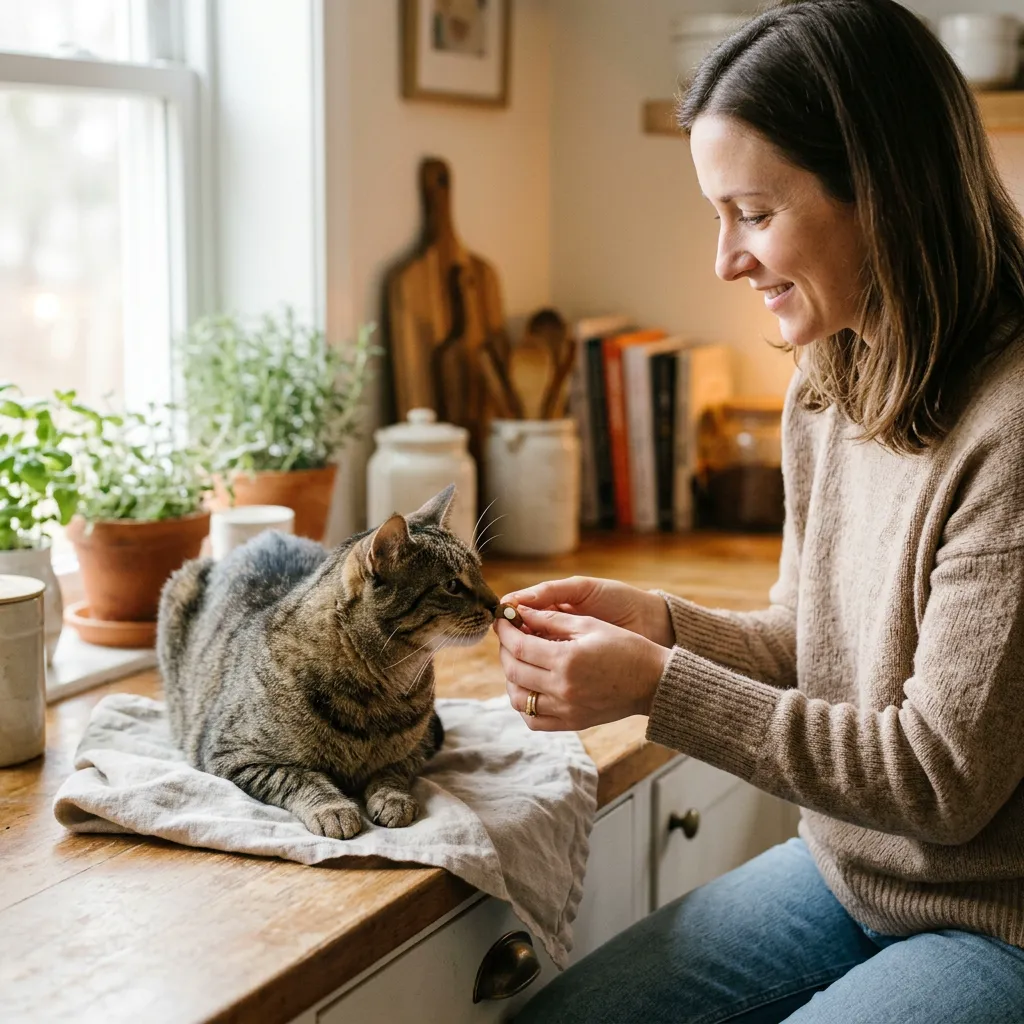
Why does your pet fight the pill (and why isn't it your fault)?
Before the how-to, it helps to understand the why — because the reasons point straight to the fixes.
When researchers in New Zealand surveyed dog owners, about one-third reported challenges giving prescribed medication, and the most common reason by far was a resistant pet.¹ A companion study of cat owners found that every owner who reported difficulty named resistance as a cause.² Cats are especially tricky: they are more discriminating than dogs, less accustomed to restraint, and one survey found that up to 45% of cats try to bite or scratch during medicating.²
The drivers are consistent across the research and clinical experience:
- Taste and smell. Many medications are bitter or have an off-putting odor. Studies show pets accept palatable, species-formulated drugs far more readily — liquid feline formulations were rated nearly five times more palatable than solid ones in one cat survey.⁷
- The stress of restraint. Pets pick up on tension. Clinicians put it simply: if you are anxious, your pet will reflect it.³
- Learned dread. One bad pilling session teaches your pet that the medicine cabinet means trouble — and the next time is harder. This is exactly why positive reinforcement and low-stress handling matter so much.⁵
- No one showed you how. In both the dog and cat studies, roughly 45–47% of owners said nobody ever demonstrated how to give the medication.¹² Poor technique doesn't just make it harder — it can reduce the dose your pet actually receives.
Important medical disclaimer: SteadyTails is a tracking and coordination tool, not a source of veterinary advice. The techniques below are general reference information. Always confirm with your veterinarian whether a specific medication can be given with food, crushed, or split — and ask them to demonstrate technique for your individual pet.
How do you hide a pill in food (the easiest win)?
For most pets, you never need to pry open a mouth. The majority of cat owners in research reported giving medication with food or a treat rather than directly by hand,² and "hide it in something delicious" is the first-line advice from Cornell, VCA, and International Cat Care alike.³⁴⁸
Here's how the main methods compare, from gentlest to most hands-on, so you can start with the easiest one that fits your pet and medication:
| Method | Best for | Difficulty |
|---|---|---|
| Pill pocket / food disguise | Most dogs and food-motivated cats | Easy |
| Three-treat decoy | Suspicious pets that eat the cheese but spit the pill | Easy |
| Hand-pilling | Meds that can't go with food; pets that refuse every disguise | Moderate |
| Pill-giver device | Cats prone to biting — keeps fingers clear of teeth | Moderate |
| Compounded flavored liquid | Pets that refuse all solids (vet prescription) | Easy (needs vet) |
| Transdermal gel | Select medications; a no-mouth option (vet prescription) | Easy (needs vet) |
The high-value disguises that actually work
Owners and clinicians consistently report success hiding pills in:
- Commercial pill pockets — soft, moldable treats with a built-in cavity for the tablet.
- A pea-sized ball of canned/wet food, soft cheese, or cream cheese.
- A small piece of soft, strong-smelling meat — chicken, lamb, or deli meat.
- Lickable treats or a "churu"-style purée for cats, with the pill folded in.
- A smear of peanut butter for dogs — but only after confirming it is xylitol-free, as xylitol is toxic to dogs.
Keep three rules in mind. First, make the disguise small — no bigger than a pea — so your pet swallows it whole instead of chewing and discovering the pill.⁹ Second, offer it when your pet is hungry; with your vet's okay, a slightly delayed meal makes the treat far more tempting.⁸ Third, watch them swallow — cats in particular are famous for holding a pill in their cheek and spitting it out later.
The decoy trick for suspicious pets
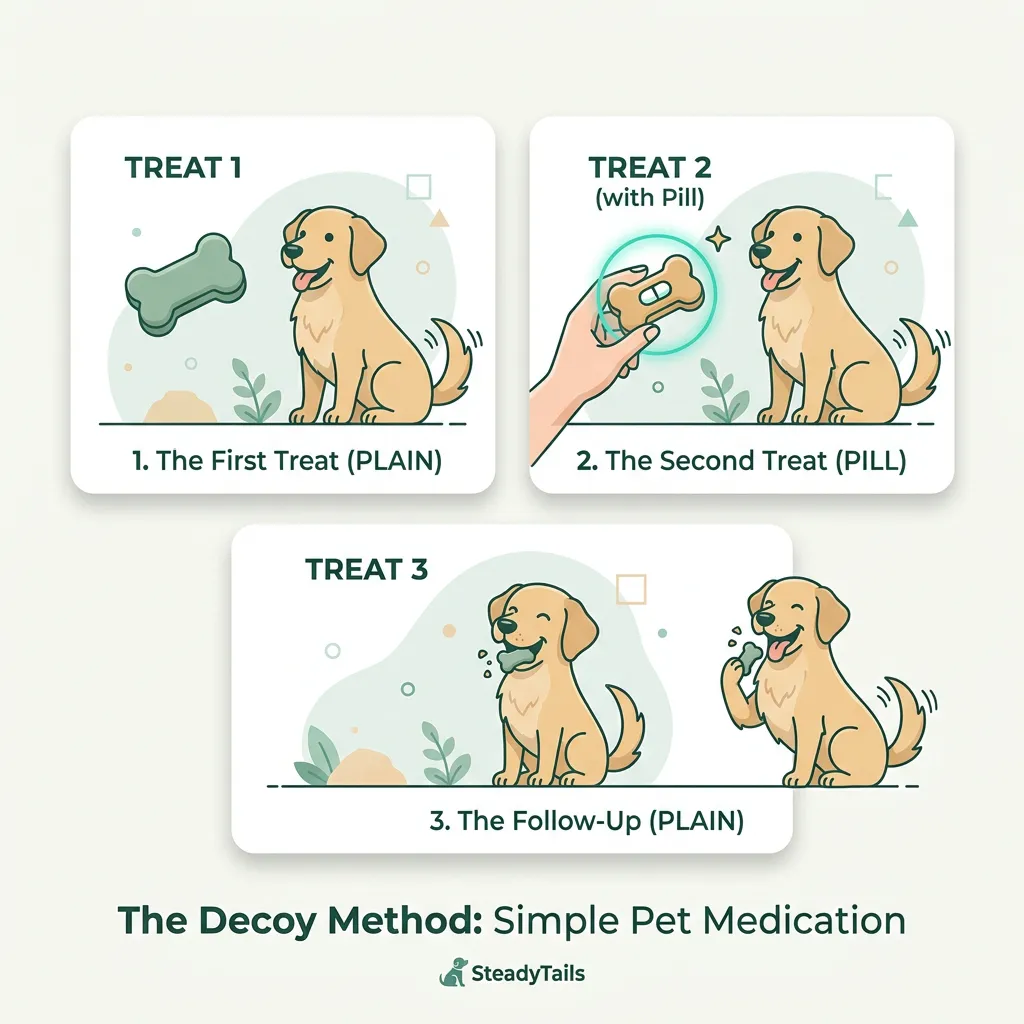
If your pet has caught on, use the "three-treat" decoy method that both owners and Low-Stress-Handling vets recommend:⁵¹⁰ give one or two identical plain treats first so your pet expects an easy snack, then hand over the treat with the pill inside, then immediately follow with another plain treat. The rhythm gets them gulping without inspecting. For dogs, "accidentally" dropping the pill-treat on the floor can make it even more irresistible.
One important caution on crushing and mixing: if your pet is too clever for whole pills, you may be tempted to crush the tablet into food. Sometimes that's fine — but never do it without checking first. Many tablets have enteric or extended-release coatings that must stay intact, and a few drugs are unsafe to handle crushed.⁴⁸ Ask your vet or pharmacist, and if approved, mix into only a small amount of food so the full dose gets eaten.
When food doesn't work: how do you hand-pill safely?
Some medications can't be given with food, and some pets refuse every disguise. In that case you'll need to place the pill directly in the mouth — a process called "pilling." Done correctly, it takes seconds. The technique below is synthesized from Cornell, VCA, and International Cat Care guidance.³⁴⁸
Step-by-step: giving a pill by hand
- Prepare everything first. Have the pill ready (lubricate it with a dab of butter or gravy so it slides down), plus a syringe of water and a reward. Choose a calm, quiet spot and only fetch your pet once you're set.³
- Settle and gently secure your pet. For a cat, many people wrap the body in a towel ("purrito") with just the head out, or place the cat in their lap facing away. Approach from the side, not from above — it's less threatening.⁸ Never heavily restrain a struggling pet; if they're panicking, stop.
- Open the mouth. Hold the head from above, thumb on one side of the upper jaw and fingers on the other. Tilt the nose gently upward toward the ceiling — the lower jaw will naturally drop. Use a finger of your pilling hand to ease the lower jaw open further.⁴
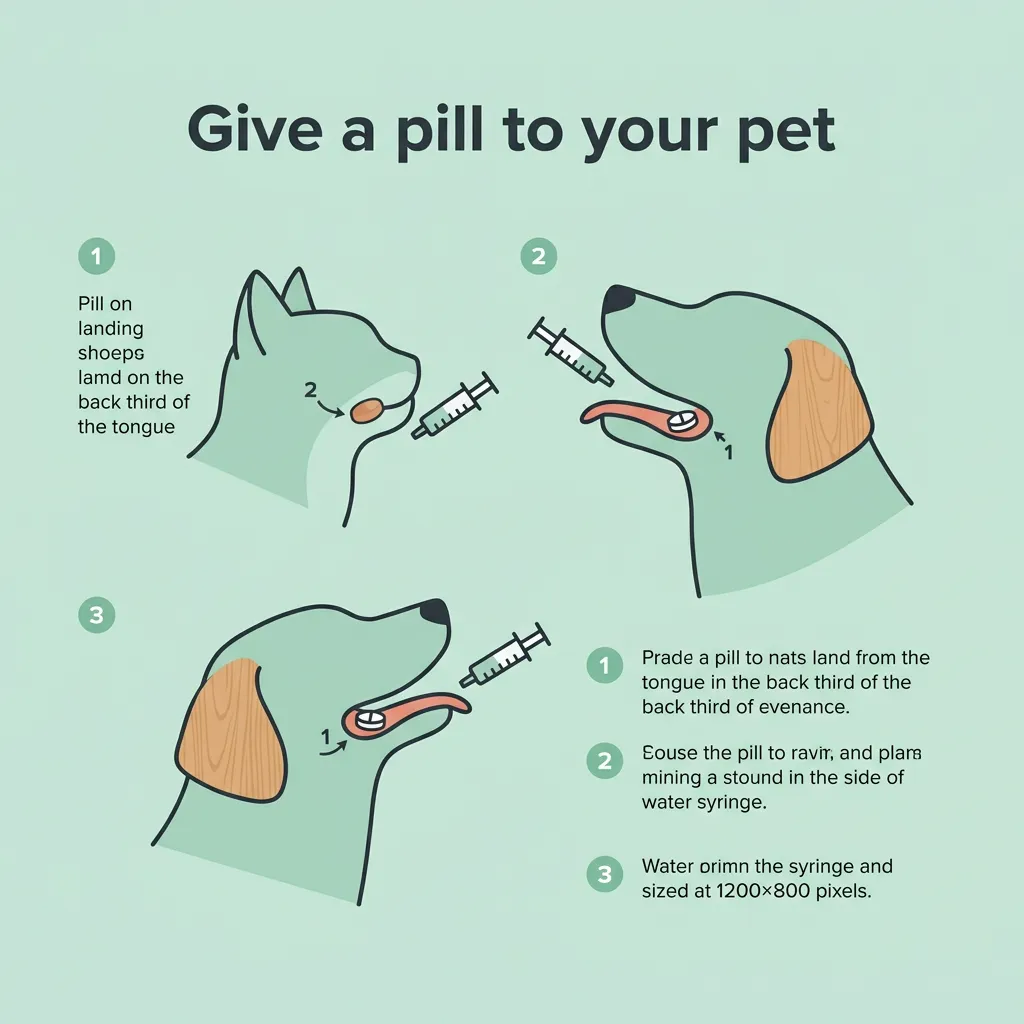
- Place the pill far back. Quickly drop or place the pill on the back third of the tongue, as far back as you can see. The further back it goes, the more likely it triggers an automatic swallow rather than getting spat out.⁸ A pill-giver device (see below) can do this without your fingers near the teeth.
- Close and encourage a swallow. Hold the mouth closed for a few seconds and gently rub the throat or blow softly on the nose. A lick of the lips or nose usually means it went down.³
- Chase with water — this part is important. Follow the pill with a small syringe of water (or a lick of a tasty liquid). Dry-swallowed tablets, especially in cats, can lodge in the esophagus and cause irritation or injury; a water chaser washes it safely to the stomach.³
- Reward immediately. Finish every session with a treat, play, or affection. This is not optional — it's what keeps the next dose from becoming a battle.⁴⁵
Helpful tools
- Pill-givers ("pill poppers"): a wand with a soft tip that holds the tablet and releases it at the back of the tongue — keeping your fingers safely away from teeth. Especially useful for cats prone to biting.⁸
- Pill splitters and empty gel capsules: a splitter divides tablets accurately, and an empty gelatin capsule can combine multiple small pills into one easy-to-give dose — both only when your vet confirms the medication can be split or combined.⁸ Splitting also matters for weight-based over-the-counter doses — see our Benadryl dosage guide for dogs.
What should you ask your vet when nothing works?
Here's the most underused tip in pet medicine: if you can't medicate your pet, that is medical information your vet needs — not something to hide. Quietly skipping doses can make a treatment look like it failed when it was never actually given. Because nearly half of owners were never shown how,¹² simply asking for a demonstration is often the fix. Beyond that, ask your vet about:
- A more palatable formulation. Chewable, flavored tablets dramatically improve acceptance, and pets take species-formulated drugs far more readily than human or generic ones.⁶⁷
- Compounding. Many pharmacies can turn a bitter tablet into a tuna-, chicken-, or salmon-flavored liquid your pet will lap up.⁴
- Transdermal gels. Some medications can be absorbed through the skin of the ear flap — no mouth involved.⁴
- A simpler schedule. Fewer daily doses are far easier to sustain. In one classic study, owners on a once- or twice-daily schedule were up to nine times more likely to be fully compliant than those dosing three times a day.¹¹ Never change timing yourself — but it's worth asking whether a longer-acting option exists.
You got the pill in. Now make sure it actually counts.
Mastering the technique solves half the problem. The other half — remembering every dose, on time, without double-dosing in a shared household — is exactly what SteadyTails is built for. Join the waitlist for early access on iOS and Android.
Join the SteadyTails waitlist →The half of the problem that technique can't solve
Let's say you've cracked it. Your dog now inhales pill pockets; your cat tolerates a quick, calm pilling with a treat afterward. You've solved the hard part — but you haven't solved everything, because giving medication well and giving it reliably are two different skills.
The same body of research that names resistance as the top barrier also shows that even motivated owners frequently mistime doses and that shared households routinely produce "I thought you gave it" confusion — which causes both missed doses and dangerous double doses. We dig into the numbers in our pillar guide on why pets miss medication doses and the household system that fixes it.
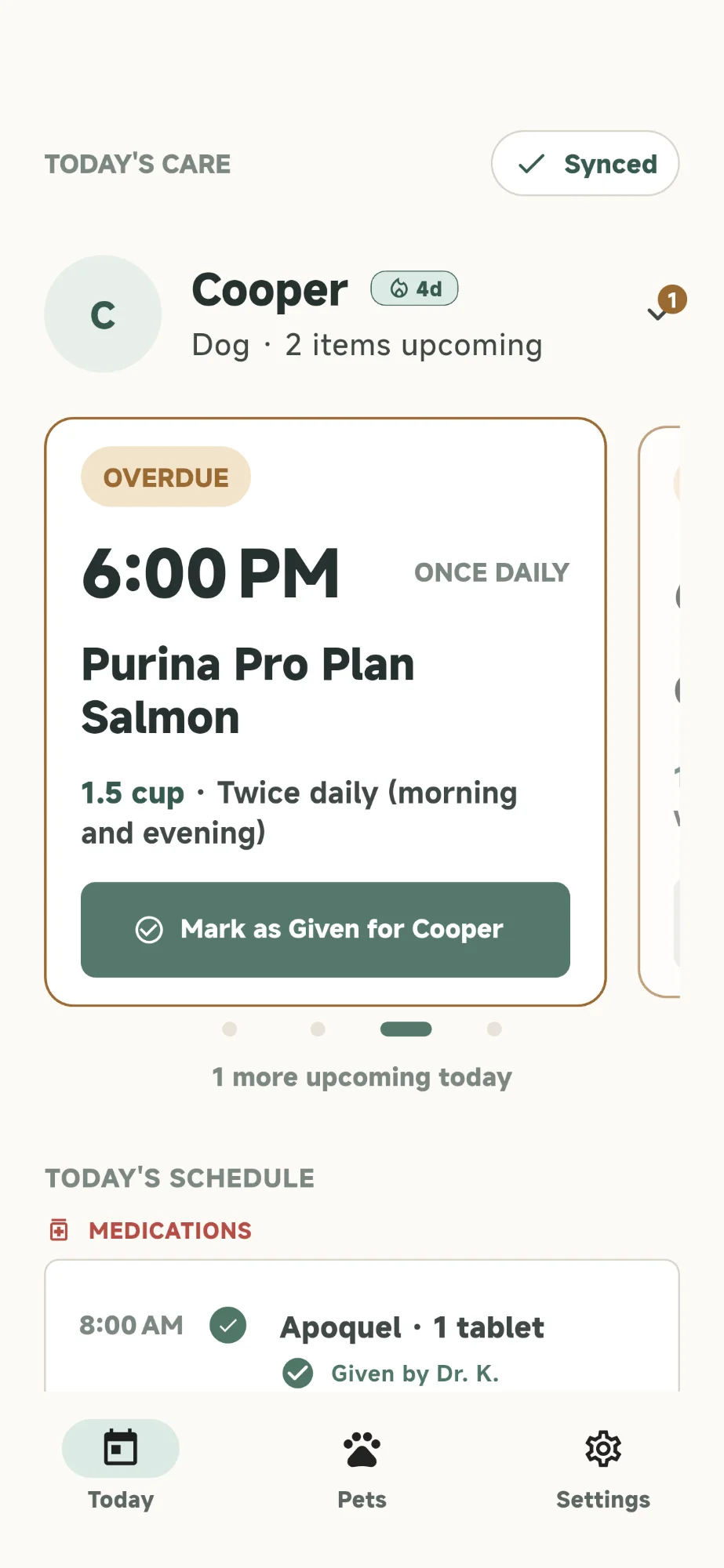
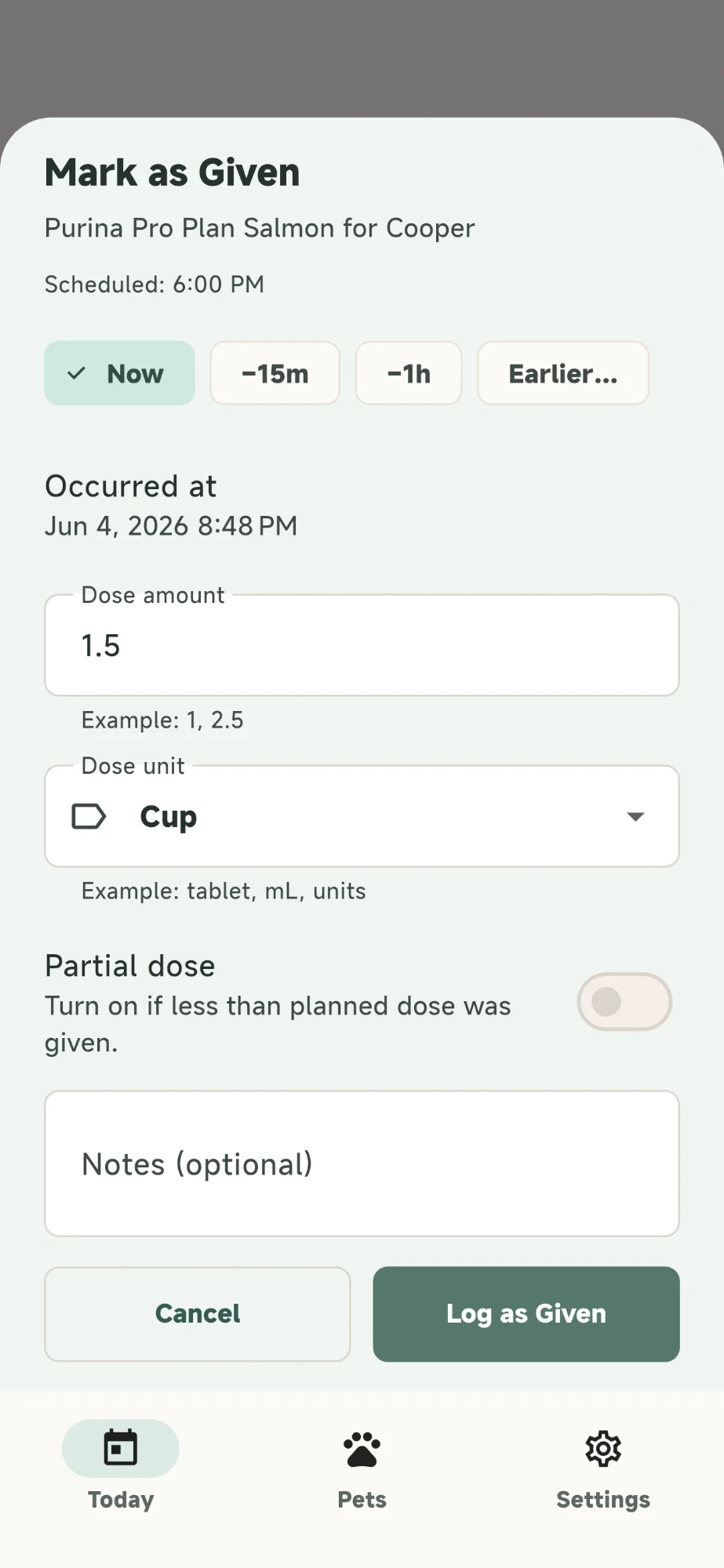
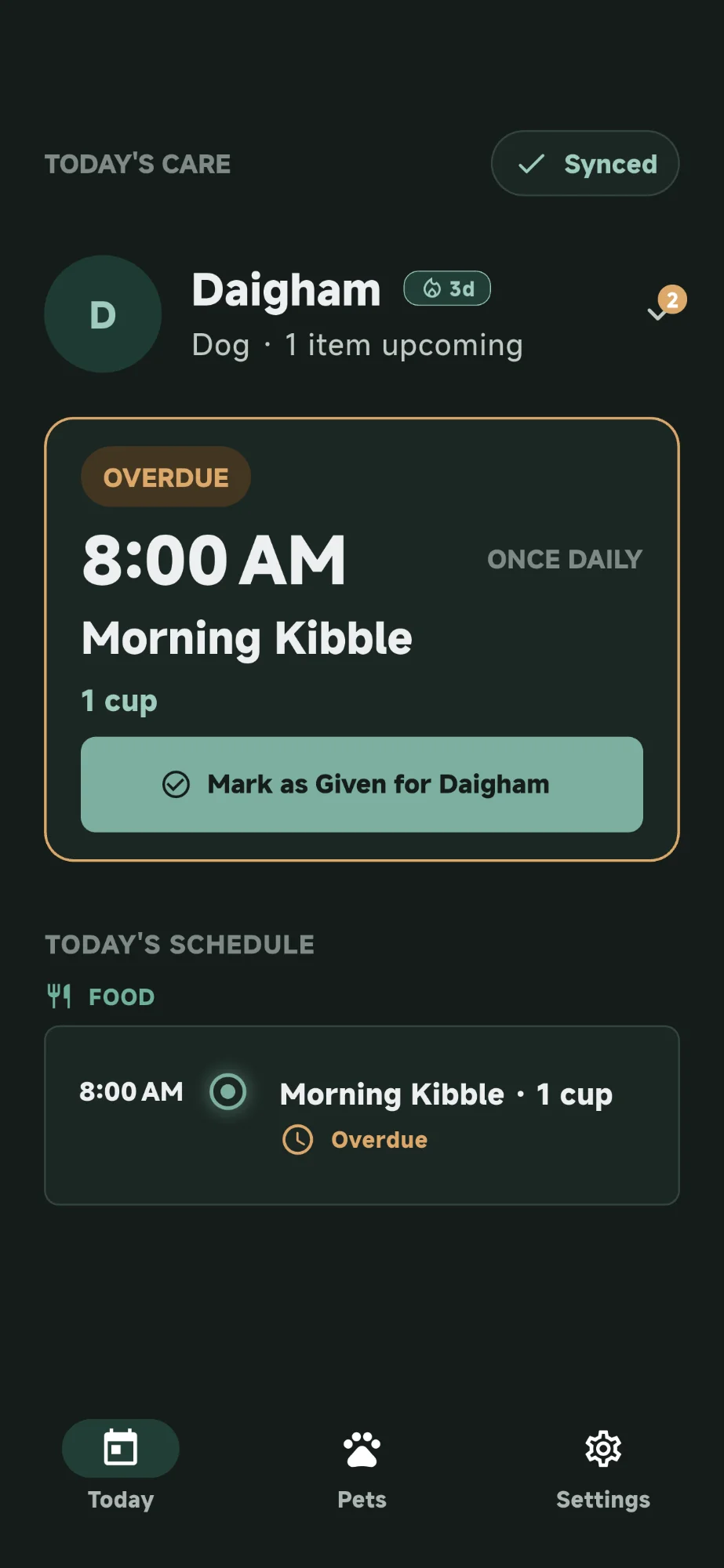
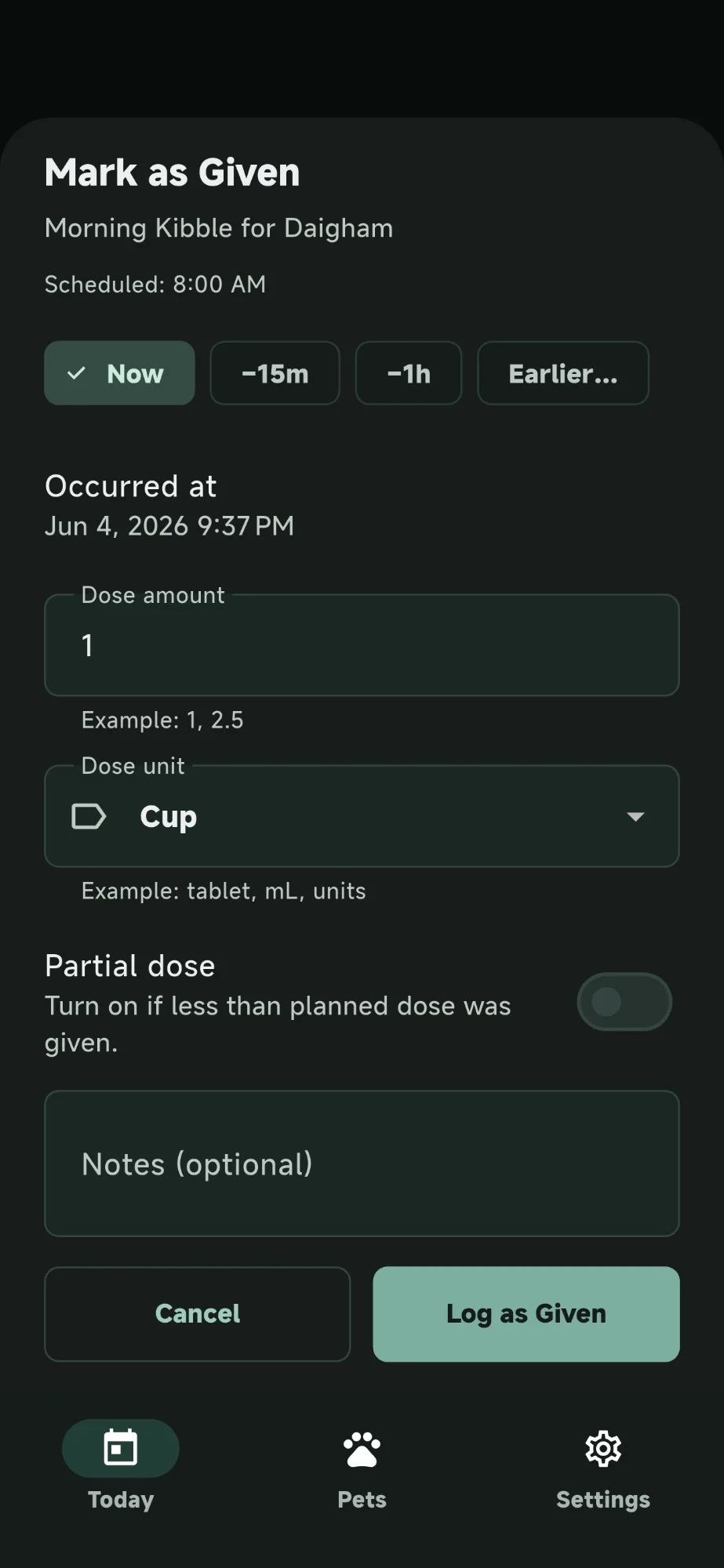
This is the gap a shared, real-time log closes. When the dose goes in, you tap "given" once — and that single action timestamps it, suppresses the reminder on every other caregiver's phone so no one re-doses, and quietly builds the history your vet will want at the next visit. You can even note that your cat spat half the pill out or your dog refused breakfast, so the picture stays honest.
Which conditions need the most dosing precision?
If the medication you're wrestling with is for a chronic condition, the stakes of getting every dose in are higher. These companion guides go deeper:
- Tracking insulin shots for a diabetic dog — why 12-hour timing and food coordination are non-negotiable, and how to prevent a hypoglycemic double dose.
- Managing strict seizure-medication intervals — keeping anti-epileptic drug levels steady on 8- and 12-hour schedules.
- What to log for a cat with chronic kidney disease — appetite, nausea, fluids, and building a vet-ready history.
- How to avoid double dosing your pet's medication — the shared-household safeguards that stop the most common at-home medication emergency.
The bottom line
A pet that fights its medicine is the most common pet-care struggle there is — not a sign you're doing anything wrong. Start gentle and food-first, keep yourself calm because your pet is watching, learn a clean hand-pilling technique for when you need it, and treat "I can't medicate my pet" as a normal, fixable conversation with your vet rather than a private failure.
Then close the loop. Once you can reliably get the dose in, a shared logging system makes sure it's never forgotten, never doubled, and always ready to show your vet. That's the quiet difference between a treatment that works on paper and one that works in real life.
From "did anyone give it?" to shared certainty
Invite every caregiver, log each dose in one tap, suppress duplicate reminders automatically, and export a vet-ready history. SteadyTails is coming soon to iOS and Android — reserve your spot free.
Get early access →References
- Hill KE, et al. Factors Associated with Medication Noncompliance in Dogs in New Zealand. Animals (MDPI), 2024;14(17):2557. PubMed Central (free full text)
- Odom TF, et al. Medication compliance by cat owners prescribed treatment for home administration. Journal of Veterinary Internal Medicine, 2025. pmc.ncbi.nlm.nih.gov/articles/PMC11724197
- Cornell University College of Veterinary Medicine. Giving Your Cat Oral Medications. vet.cornell.edu
- VCA Animal Hospitals. Giving Pills to Cats. vcahospitals.com/know-your-pet/giving-pills-to-cats
- Veterinary Partner (VIN). Pilling Your Cat the Low Stress Handling® Way. veterinarypartner.vin.com
- Frontiers in Veterinary Science. Using social media listening to identify the real-world challenges faced by dog owners when administering oral medications. 2025. frontiersin.org
- Taylor S, et al. Difficulties in administration of oral medication formulations to pet cats: an e-survey of cat owners. Veterinary Record, 2017. PubMed (free abstract)
- International Cat Care. How to give a cat medication. icatcare.org/articles/how-to-give-a-cat-medication
- Auburn University College of Veterinary Medicine. Cats and Medications. vetmed.auburn.edu
- Merck Veterinary Manual (Pet Owner Edition). Giving Medicine to a Cat. merckvetmanual.com
- Adams VJ, et al. Evaluation of client compliance with short-term administration of antimicrobials to dogs. JAVMA, 2005;226(4):567–574. avmajournals.avma.org