

Maybe it started so quietly you almost didn't notice. Your dog used to bound up the stairs and now takes them one careful step at a time. Your cat, who once rocketed to the top of the bookshelf, now jumps to the chair first — or doesn't bother at all. It's easy to file these changes under "just getting older." Very often, that's a mistake. What looks like aging is frequently arthritis — and it's one of the most common, most treatable, and most under-diagnosed conditions in dogs and cats.
This guide explains what the research actually shows about how common arthritis is, the subtle early signs owners routinely miss (especially in cats), and the single most powerful thing you can do at home: track your pet's pain and mobility consistently so you catch the trend early and keep treatment on schedule. It's the difference between reacting to a crisis and staying ahead of one.
Key takeaways
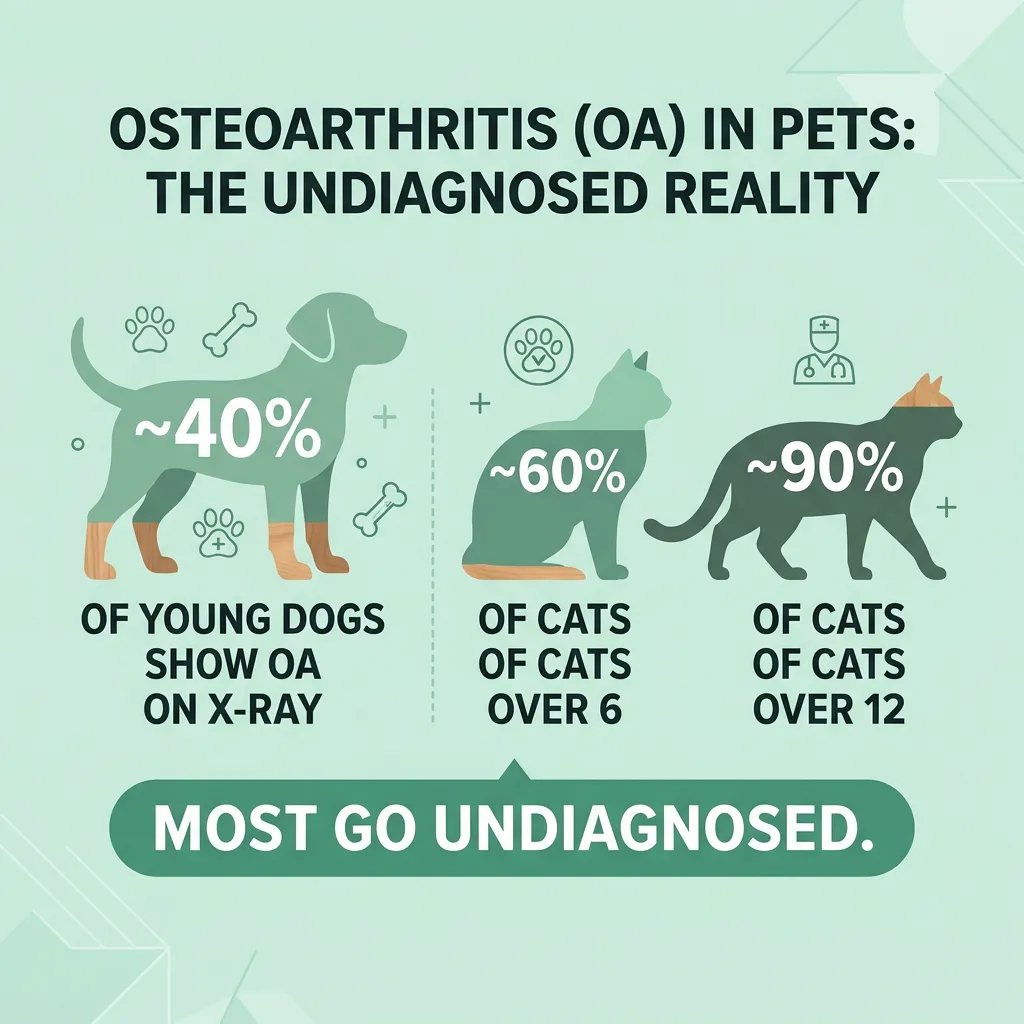
- Arthritis is everywhere — and missed everywhere. Radiographic signs appear in around 40% of dogs as young as 8 months to 4 years, yet only about 2.5% are formally diagnosed each year. The gap is under-diagnosis.¹³
- Cats hide it best. Osteoarthritis is found in roughly 60% of cats over 6 and about 90% over 12 — but they rarely limp, so owners miss it.¹⁰
- Home tracking is a clinical tool, not a nicety. Validated owner-reported mobility scores reliably detect arthritis and measure whether treatment is working.⁴⁵
- Weight is the lever you control. Even a ~3% body-weight reduction measurably improves limb loading and lameness.⁸
- Modern treatment mixes daily and monthly meds — daily NSAIDs plus once-monthly injectables like Librela (dogs) and Solensia (cats) — which makes consistent scheduling across caregivers essential.⁶⁷
How common is arthritis in dogs and cats, really?
Far more common than most owners realize. Radiographic signs of osteoarthritis turn up in roughly 40% of dogs — even young ones — and in about 90% of cats over 12, yet only around 2.5% of dogs are formally diagnosed in a given year.¹³¹⁰ The honest headline from the research is that arthritis is widespread and systematically under-recognized.
Dogs
How common arthritis looks depends entirely on how you measure it. When you count only dogs formally diagnosed by a vet in a given year, a large UK study of more than 450,000 dogs put the figure at about 2.5%.¹ But when researchers actually X-ray dogs, the picture changes dramatically: one study found radiographic evidence of osteoarthritis in roughly 40% of dogs aged just 8 months to 4 years³, and a University of Tennessee assessment found osteoarthritis in 60% of the dogs examined.² In senior dogs, prevalence estimates climb higher still. That chasm between ~2.5% diagnosed and ~40–60% present on imaging is the under-diagnosis problem in a single statistic.
Cats
Cats are the masters of disguise. Because they rarely show obvious lameness, feline arthritis was historically assumed to be rare — but imaging studies tell a very different story. Osteoarthritis is detected in roughly 60% of cats older than 6 years and about 90% of cats older than 12.¹⁰ In other words, if you share your home with a middle-aged or senior cat, the odds that their joints are affected are high — even if you've never once seen them limp.
What are the early signs of arthritis owners miss?
The reason arthritis goes undiagnosed isn't that owners don't care — it's that the early signs are quiet, gradual, and easy to blame on age. Pets don't tell us they hurt; they simply do a little less. Recognizing these subtle behavioral shifts is the key to catching arthritis early, when intervention helps most.⁷
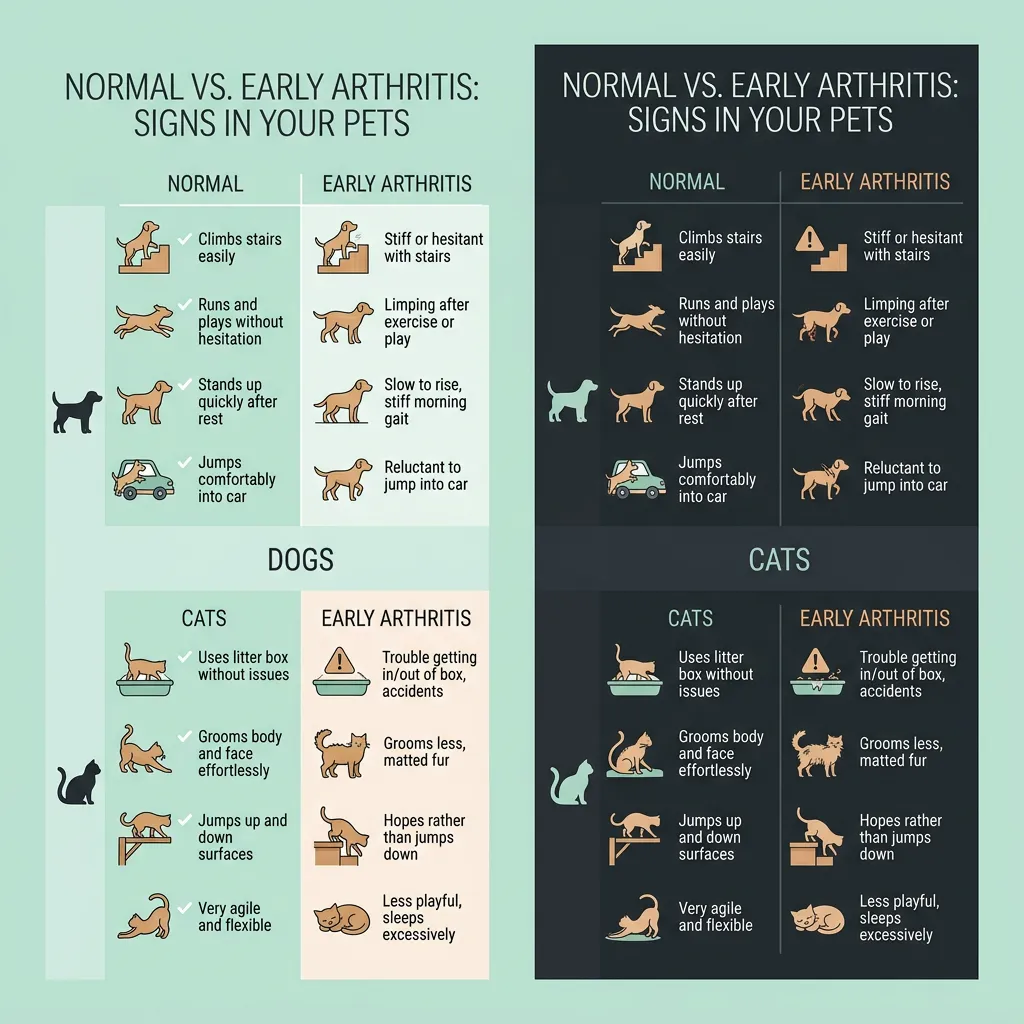
In dogs, watch for:
- Lagging behind on walks or wanting them shorter than before.
- Stiffness after rest — slow or wobbly when getting up, especially in the morning or after a nap, that "warms out" with movement.
- Hesitation at stairs, the car, or the couch — pausing, gathering themselves, or needing a running start to jump.
- Behavior changes — less enthusiasm for play, irritability when touched, or licking repeatedly at a joint.
In cats, watch for (this is harder):
- Jumping to lower surfaces, or in stages — to the chair instead of the counter, or counter-to-floor in two hops.
- Litter box trouble — going just outside the box because stepping over a high lip hurts.
- A scruffy or matted coat from reduced grooming, particularly over the back and hindquarters.
- Sleeping more, hiding, and reduced tolerance for handling or being picked up.
Because the same underlying joint pain shows up so differently in each species, it helps to see them side by side. Here's how the early signs typically map from dogs to cats:
| Early sign | In dogs | In cats |
|---|---|---|
| Getting around | Lags on walks, hesitates at stairs, the car, or the couch | Jumps to lower surfaces or in two stages; stops reaching high perches |
| Rising after rest | Stiff or wobbly getting up, eases once "warmed up" | Sleeps more; slow and cautious to settle or rise |
| Grooming & coat | Licks or chews repeatedly at a joint | Scruffy, matted coat over the back and hindquarters |
| Litter box / toileting | Reluctant to squat or posture | Goes just outside the box — a high lip hurts to step over |
| Mood & handling | Less enthusiasm for play; irritable when touched | Hides more; less tolerant of handling or being picked up |
Why does tracking arthritis at home change everything?
Here's the insight that turns under-diagnosis around: you don't need to be a vet to detect arthritis — you need to be a consistent observer. The veterinary field increasingly relies on owner-reported outcome measures precisely because you see your pet every day, across hundreds of ordinary moments a clinic exam can never capture.
The evidence is strong. A 2022 study showed that a structured, owner-completed questionnaire could identify previously undiagnosed osteoarthritis, and that owner-scored functional mobility tests reliably tracked improvement once treatment began.⁴ Newer validated tools like GenPup-M were built specifically to detect early mobility changes from owner observations.⁵ These instruments all work the same way: they score everyday activities — walking, rising after rest, climbing stairs, jumping — and watch how they change over time.
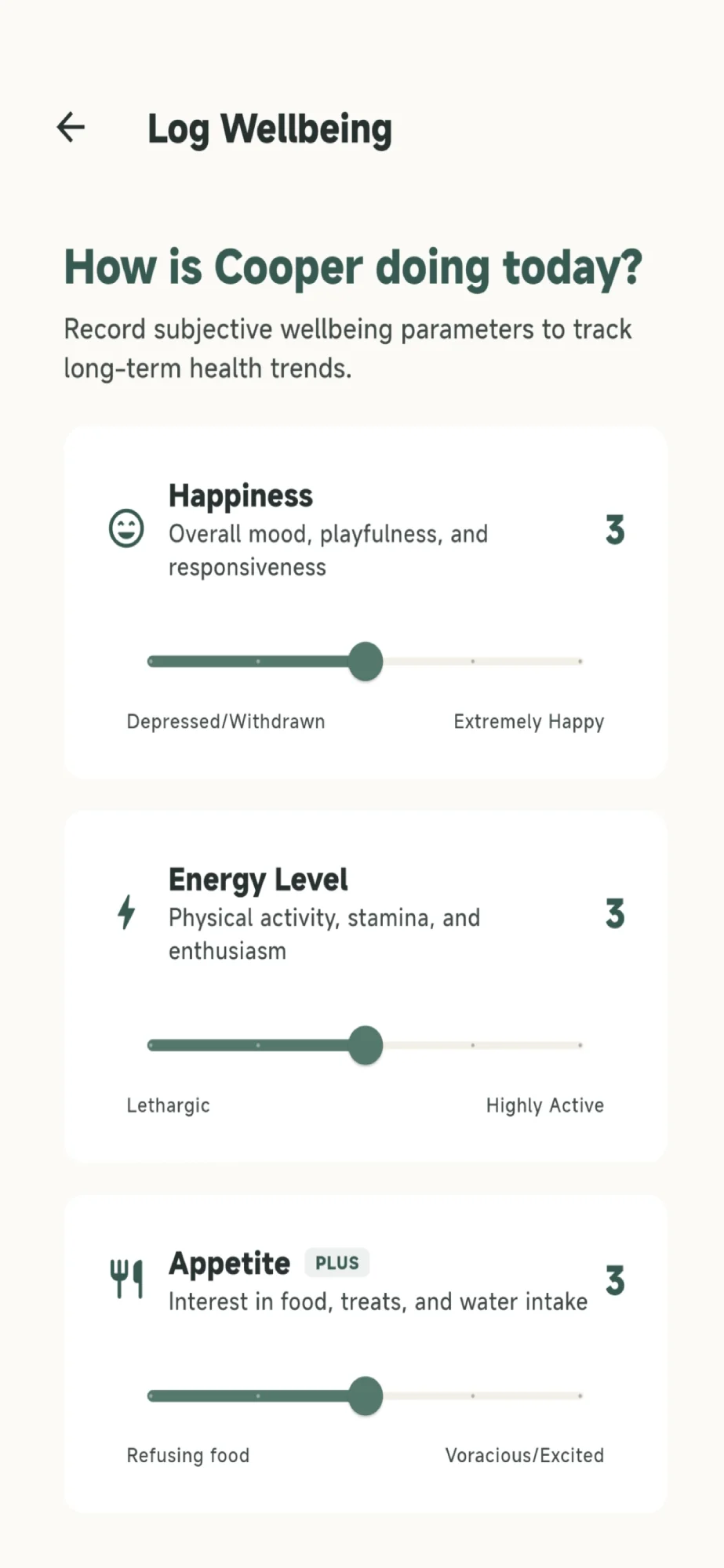
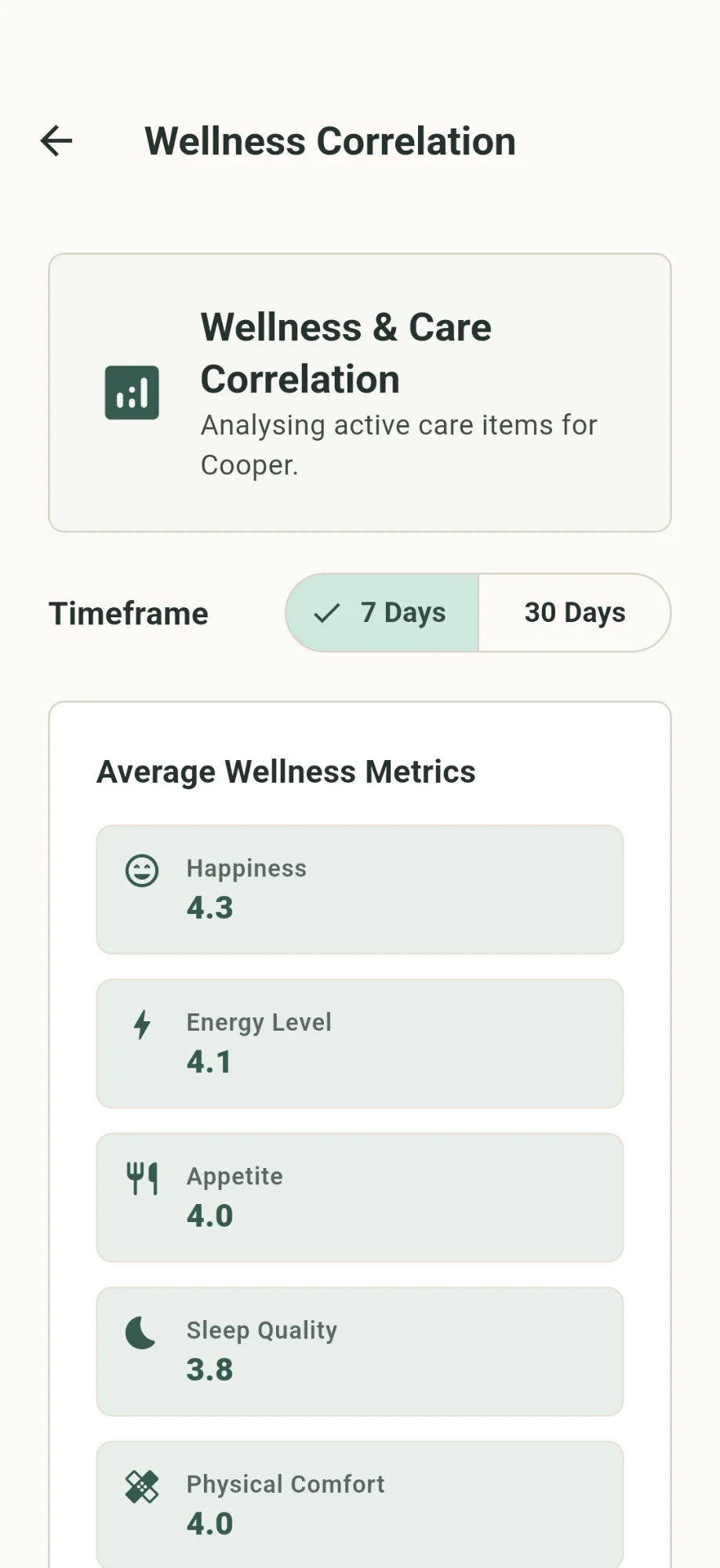
And over time is the crucial phrase. A single stiff morning tells you almost nothing; pets have good days and bad days. But a clear three-week downward trend in mobility, or a steady climb back up after starting a new medication, tells you and your vet everything. This is exactly where memory fails and a simple, consistent log wins.
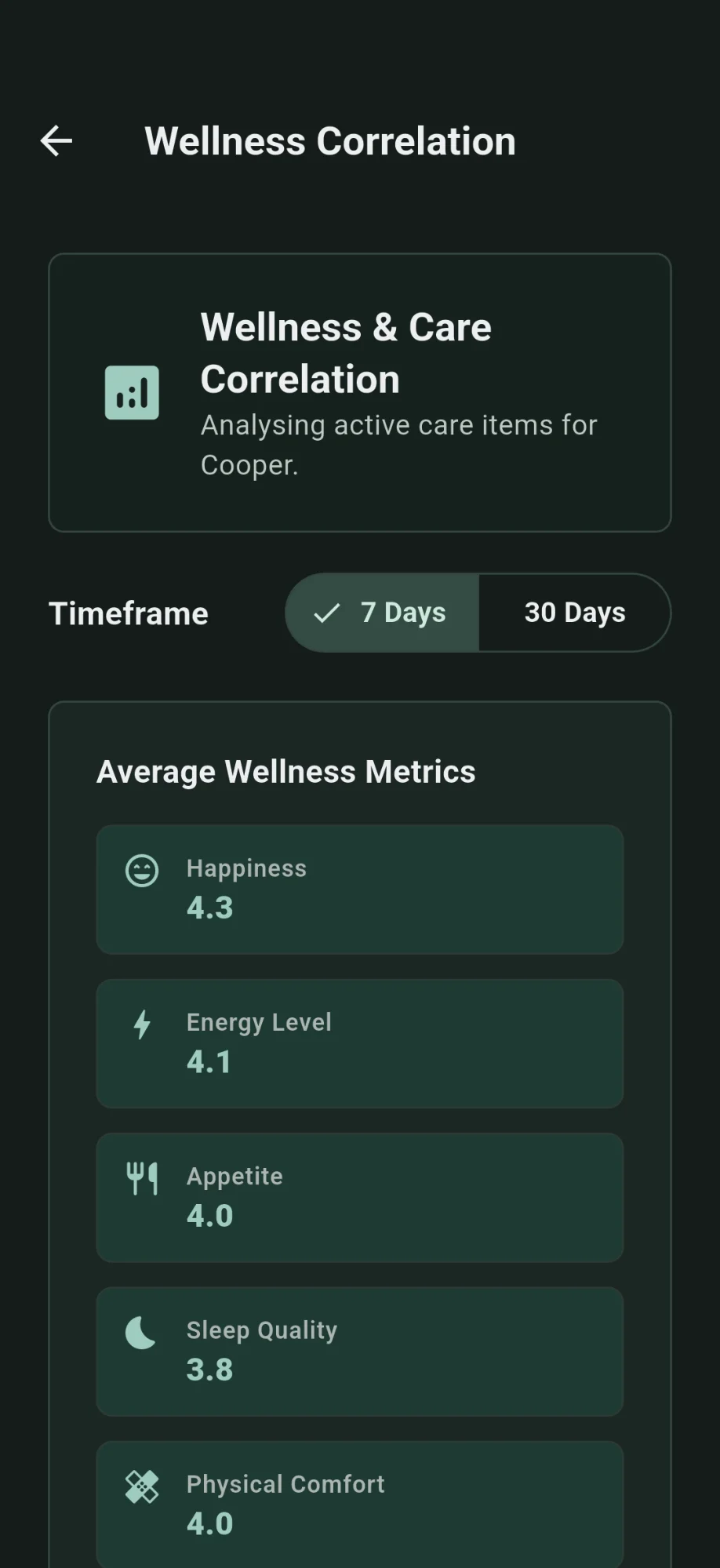
This is the heart of what SteadyTails is built to do. Instead of trying to remember whether last Tuesday was better or worse, every caregiver logs a quick daily comfort, energy, and mobility rating. Those ratings become a trend line — the same kind of signal the validated questionnaires capture — that surfaces a problem early and shows whether treatment is actually working. Join the waitlist to put that trend in your pocket.

What treatments does the evidence support?
Arthritis can't be cured, but it can be managed extremely well. The research is consistent on one point above all: a multimodal plan — several complementary strategies together — beats any single intervention.⁹ Here are the pillars, all to be built with your veterinarian.
1. Weight management — the lever you control most
If your pet carries extra weight, this is the highest-impact change available, and it's free. Excess weight loads the joints mechanically and fuels inflammation biologically. The payoff is measurable: dogs with osteoarthritis show clinical improvement and a measurable increase in limb loading (peak vertical force) after even a ~3% reduction in body weight.⁸ Ask your vet to assign a body condition score (the target is typically 4–5 on a 9-point scale) and a realistic plan to reach it.
2. Pain medication — daily and monthly options
Two broad categories matter today:
- NSAIDs (non-steroidal anti-inflammatory drugs) such as carprofen, meloxicam, or grapiprant. These are the long-standing backbone of arthritis pain control, usually given by mouth at home every day. In studies, dogs newly treated with carprofen showed significant mobility gains within 30 days.⁴
- Anti-NGF monoclonal antibodies — a newer class given as a once-monthly injection at the clinic. Librela (bedinvetmab) became the first monoclonal antibody FDA-approved for osteoarthritis pain in dogs in May 2023⁶, and Solensia (frunevetmab) was FDA-approved for cats in January 2022, with about 77% of owners reporting improvement.⁷
Both classes are prescription-only and carry real considerations — NSAIDs require monitoring, and Librela has been the subject of ongoing post-marketing safety surveillance. Your veterinarian decides what's right for your pet, and pain medications should never be combined without their explicit direction.
3. Everything else that adds up
- Joint-supporting nutrition and supplements (for example omega-3 fatty acids, and prescription joint diets) as advised by your vet.
- Controlled exercise and physical rehabilitation — consistent, low-impact activity and, where available, hydrotherapy or a rehab program.
- Home modifications — ramps, orthopedic bedding, non-slip rugs over slick floors, and a low-sided litter box for cats.
Important medical disclaimer: SteadyTails is a tracking and coordination tool. It does not provide veterinary advice, diagnosis, treatment, or dosing recommendations. Arthritis diagnosis and every element of a treatment plan — including which medications to use and whether they can be combined — must come from your veterinarian.
The adherence trap: when "simple" arthritis care isn't simple
Here's the part that catches families off guard. A well-managed arthritis plan often looks like this: a daily NSAID at breakfast, a joint supplement, a monthly clinic injection, and a weight-loss feeding routine — frequently shared across a partner, a family member, and the occasional pet sitter. That combination of multiple medications and multiple caregivers is exactly where things slip.
The research backs this up: roughly half of pet owners don't give medication exactly as prescribed, and shared households are especially prone to the "I thought you gave it" gap — which causes both missed doses and dangerous double doses. We unpack the numbers in our pillar guide on why pets miss medication doses and the household system that fixes it, and the double-dose safeguards in how to avoid double dosing your pet's medication.
Arthritis adds two unique wrinkles. First, the monthly injection is easy to lose track of — "did we book this month's Librela?" — because it isn't part of the daily rhythm. Second, if the daily NSAID is one your pet resists, you're back to the most common reason doses get skipped (our guide on giving a dog or cat a pill without the fight covers that). A shared timeline that logs every dose the moment it's given, suppresses duplicate reminders across all devices, and tracks the monthly injection alongside the daily meds is what keeps the whole plan from quietly falling apart.
Catch the trend before it becomes a crisis
SteadyTails turns daily observations into a clear mobility and comfort trend, keeps every caregiver in sync on daily and monthly medications, and exports a vet-ready report for your next visit — so arthritis is something you manage together, calmly. Join the waitlist for early access on iOS and Android.
Join the SteadyTails waitlist →How do you turn home tracking into a better vet visit?
Arthritis decisions are made on patterns, not snapshots. Is your pet better or worse than a month ago? Did the new medication actually help, or did you just hope it did? Is today a bad day or part of a bad week? A consistent home record answers all of these — and turns a vague "she seems a bit stiff lately" into "her mobility scores dropped after we tapered the NSAID three weeks ago, here's the graph."
That's the kind of objective, owner-reported data the validated instruments are built around⁴⁵, and it's exactly what makes an appointment productive. Pair this guide with our senior dog and cat care checklist if your arthritic pet is also entering their senior years — the two go hand in hand.
The bottom line
Arthritis isn't a quiet, inevitable part of your pet "just slowing down" — it's a common, manageable medical condition that's badly under-diagnosed because its early signs are so easy to miss. You have more power here than you think. Learn the subtle signs, track mobility and comfort consistently so the trend speaks for itself, build a multimodal plan with your vet, and keep every daily and monthly treatment on schedule across your whole household. Do that, and you give your dog or cat the best shot at staying comfortable, active, and themselves for years longer.
Give your pet's joints a single source of truth
Track mobility and comfort trends, coordinate daily NSAIDs and monthly injections across every caregiver, prevent missed and doubled doses, and hand your vet a clean PDF report. SteadyTails is coming soon to iOS and Android — reserve your spot free.
Get early access →References
- Anderson KL, et al. Prevalence, duration and risk factors for appendicular osteoarthritis in a UK dog population under primary veterinary care. Scientific Reports, 2018. nature.com/articles/s41598-018-23940-z
- Today's Veterinary Practice. Study Shows High Prevalence of OA (60%) in Canine Patients. todaysveterinarypractice.com
- Enomoto M, et al. Prevalence of radiographic appendicular osteoarthritis and associated clinical signs in young dogs. Scientific Reports, 2024. nature.com/articles/s41598-024-52324-9
- Wright A, et al. Identification of canine osteoarthritis using an owner-reported questionnaire and treatment monitoring using functional mobility tests. Journal of Small Animal Practice, 2022. pmc.ncbi.nlm.nih.gov/articles/PMC9543207
- Belshaw Z, et al. GenPup-M: a novel validated owner-reported clinical metrology instrument for detecting early mobility changes in dogs. 2023. ncbi.nlm.nih.gov/pmc/articles/PMC10752556
- U.S. Food and Drug Administration. FDA Approves First Monoclonal Antibody for Dogs with Osteoarthritis Pain (Librela / bedinvetmab). May 2023. fda.gov
- Zoetis. FDA Approval of Solensia (frunevetmab injection) to Control Osteoarthritis Pain in Cats. January 2022. news.zoetis.com
- Marshall WG, et al. The effect of weight loss on lameness in obese dogs with osteoarthritis. Veterinary Research Communications, 2010. PubMed Central (free full text)
- Mille MA, et al. A multimodal approach to canine osteoarthritis management: a state-of-the-art review. PMC, 2025. pmc.ncbi.nlm.nih.gov/articles/PMC12861432
- Gruen ME, et al. Osteoarthritis in cats: what we know, and mostly, what we don't know yet. PMC, 2024. pmc.ncbi.nlm.nih.gov/articles/PMC12277680