

One morning you notice your dog hesitating at the bottom of the stairs, or your cat no longer making the leap to the windowsill she's owned for a decade. It's easy to file these moments under a single, resigned heading: getting old. But here's what veterinarians want every pet parent to know — a great deal of what we write off as "just age" is actually treatable. Aging itself is not a disease, and the senior years can be some of the most comfortable and connected of your pet's life when you know what to watch for.
This guide is a calm, practical checklist for caring for a senior dog or cat: when "senior" actually begins, what genuinely changes inside an aging body, what to do every single day, and the red flags that mean it's time to call the vet now rather than wait. It's grounded in current veterinary guidance — not folk wisdom — and built for the reality that senior care is usually shared across a household.
Key takeaways
- "Senior" starts earlier than you think. Veterinary guidelines define it as roughly the last 25% of lifespan — about age 7 for many dogs (earlier for big breeds) and around 10 for cats.¹
- Twice-yearly vet exams are the standard. Pets age 5–7× faster than people, so a year between checkups is like 5–7 human years.¹²
- Pain hides as "slowing down." Osteoarthritis is extremely common in older pets — found in well over half of some senior dog joints and radiographically in up to ~90% of older cats — yet routinely mistaken for normal aging.³⁵⁷
- A shared daily system is the quiet superpower. Multiple medications + multiple caregivers is how doses slip; one real-time, vet-ready log prevents both missed and doubled doses.
When does a pet actually become "senior"?
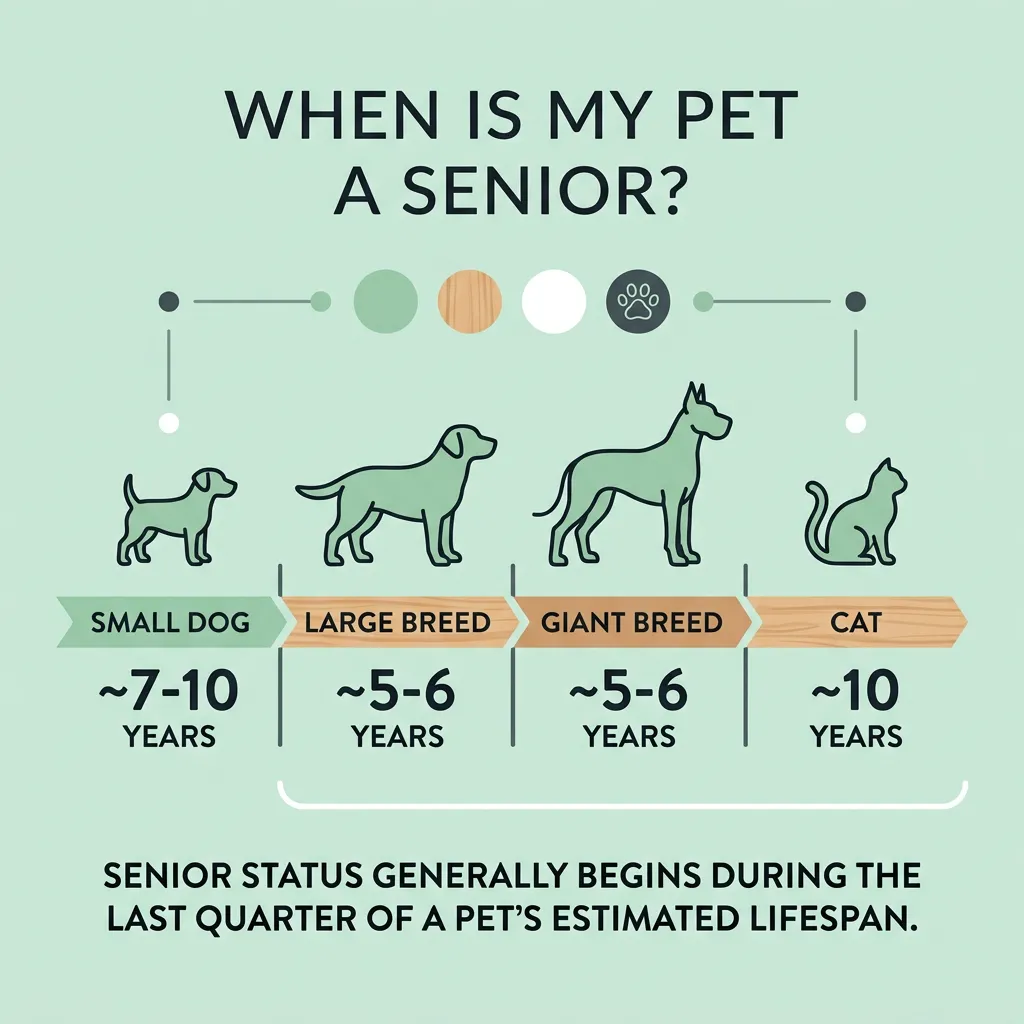
There is no single birthday that flips the switch. The most widely used framework comes from the American Animal Hospital Association (AAHA), whose 2023 Senior Care Guidelines define the senior life stage as approximately the last 25% of a pet's estimated lifespan, continuing through end of life.¹ In everyday terms:
- Dogs: often around age 7 — but size matters enormously. Large and giant breeds age faster and may be "senior" by 5–6, while small dogs may not get there until 9 or 10.
- Cats: generally around age 10, entering their "geriatric" years in the mid-teens.
Why does the label matter? Because it should change how proactively you monitor. Dogs and cats age roughly five to seven times faster than humans, which means a single year between checkups is comparable to a person going five to seven years without seeing a doctor.² That's why veterinary guidance shifts senior pets from annual to twice-yearly wellness exams — conditions like kidney disease, diabetes, feline hyperthyroidism, and osteoarthritis can progress dramatically inside a single year.¹
What actually changes as pets age?
Aging touches nearly every system, but joints lead the list: radiographic osteoarthritis shows up in as many as ~90% of geriatric cats and in over half of some senior dog joints, and it's the most commonly overlooked change of all.³⁵ Understanding what's happening under the surface turns vague worry into a concrete plan. These are the systems that most commonly shift in senior dogs and cats.
Mobility and joints
Osteoarthritis (OA) is one of the most under-recognized conditions in older pets. In dogs over eight years old, one study found radiographic OA in 57.4% of elbows, 39.2% of shoulders, 35.9% of hips, and 36.4% of stifles (knees).³ In cats it's even more hidden: radiographic evidence of OA appears in a very high share of older cats — by some estimates up to around 90% of geriatric cats — yet feline arthritis is dramatically under-diagnosed because cats mask pain so well.⁵ Crucially, surveys show many owners mistake this pain for normal aging,⁷ which means the single most treatable cause of "slowing down" often goes untreated.
Cognition and behavior
Just like people, aging pets can experience cognitive decline. Canine cognitive dysfunction (the dog equivalent of dementia) has an estimated prevalence of roughly 14–35% across the senior dog population, and it rises steeply with age — affecting a minority of dogs at 11–12 but the majority by 15–16.⁶ Signs include disorientation, altered sleep-wake cycles, pacing at night, house-soiling, and reduced interaction. Cats experience analogous changes, often showing up as nighttime yowling or confusion.
Organs and metabolism
Senior pets are far more likely to develop chronic internal conditions — chronic kidney disease (especially common in older cats), diabetes, heart disease, liver changes, and thyroid disorders (hyperthyroidism in cats, hypothyroidism in dogs). Many of these are silent in their early stages, which is precisely why twice-yearly exams and routine senior bloodwork matter so much: they catch problems while they're still manageable. To get the most from each appointment, see our complete vet-visit preparation checklist.
Teeth, weight, and senses
Dental disease becomes increasingly common and painful with age and can quietly suppress appetite. Body weight cuts both ways — excess weight accelerates arthritis and chronic disease, while unexplained weight loss can be an early warning sign of something serious. And gradual loss of hearing or vision is common; pets compensate so smoothly that owners often don't notice until it's advanced.
The senior pet daily care checklist
This is the heart of it. None of these steps is complicated on its own — the challenge is doing them consistently, every day, often across more than one person. Use this as your daily framework.
| Daily task | Frequency | Why it matters |
|---|---|---|
| Medication & supplements | Every scheduled dose | Keeps blood levels stable; prevents missed and doubled doses |
| Mobility & comfort | Daily | Traction, ramps, and orthopedic bedding cut joint strain and fall risk |
| Diet, hydration & weight | Daily; weigh regularly | Excess weight worsens arthritis and chronic disease; weight change is an early warning |
| Wellness observations | Daily | Appetite, energy, toileting, and thirst catch problems early |
| Enrichment & environment | Daily | Predictable routine and gentle stimulation ease cognitive decline |
1. Medication & supplements
- Give every dose on time. Senior pets frequently take multiple medications on different schedules; consistency is what keeps blood levels stable and conditions controlled.
- Log each dose the moment it's given — so the next caregiver knows it's done and no one accidentally repeats it.
- Never "catch up" a missed dose by doubling. For drugs like insulin or anti-seizure medication, that can be dangerous. When in doubt, call your vet.
- Track refills so you never run out of a chronic medication over a weekend.
2. Mobility & comfort
- Provide traction on slippery floors (rugs, runners) and consider ramps or steps for getting onto beds and into cars.
- Offer orthopedic bedding and keep food, water, and litter boxes easy to reach — low-sided litter boxes for stiff cats.
- Maintain gentle, regular exercise appropriate to their ability; note any new limping, stiffness, or reluctance to move.
3. Diet, hydration & weight
- Feed an age- and condition-appropriate diet (confirm with your vet — especially prescription diets for kidney disease).
- Keep a close eye on body condition; weigh regularly and flag any trend up or down.
- Ensure easy access to fresh water; multiple stations help, particularly for cats.
4. Daily wellness observations
- Appetite: Did they eat normally, or pick at food / walk away?
- Energy & comfort: Brighter or more withdrawn than usual? Any signs of pain? Learn the quiet signs in dogs and in cats.
- Toileting: Changes in frequency, accidents, straining, or appearance.
- Water intake: Sudden increased thirst is an important early warning for several senior conditions.
5. Enrichment & environment
- Keep routines predictable — consistency is reassuring for pets with cognitive changes.
- Offer gentle mental stimulation (food puzzles, short sniffy walks, play) scaled to their ability.
- Maintain warmth and easy navigation, especially for pets with stiff joints or fading senses.
Red flags: when should you call the vet now?
Some changes warrant prompt veterinary attention rather than "let's watch it." Contact your vet — or an emergency clinic — if you notice:
- Sudden loss of appetite, repeated vomiting, or diarrhea
- A marked increase in thirst and urination
- Difficulty breathing, collapse, or sudden weakness
- Inability to stand, walk, or use the back legs
- A seizure, or unusual disorientation and distress
- Straining to urinate or producing little/no urine (a feline emergency in particular)
- Rapid, unexplained weight loss
- Any change that feels like a sharp departure from your pet's normal
Medical disclaimer: SteadyTails is a tracking and coordination tool. It does not provide veterinary advice, diagnosis, treatment, or dosing recommendations. This article is educational and not a substitute for an exam by your veterinarian, who knows your individual pet.
Why does a shared system matter more as pets age?
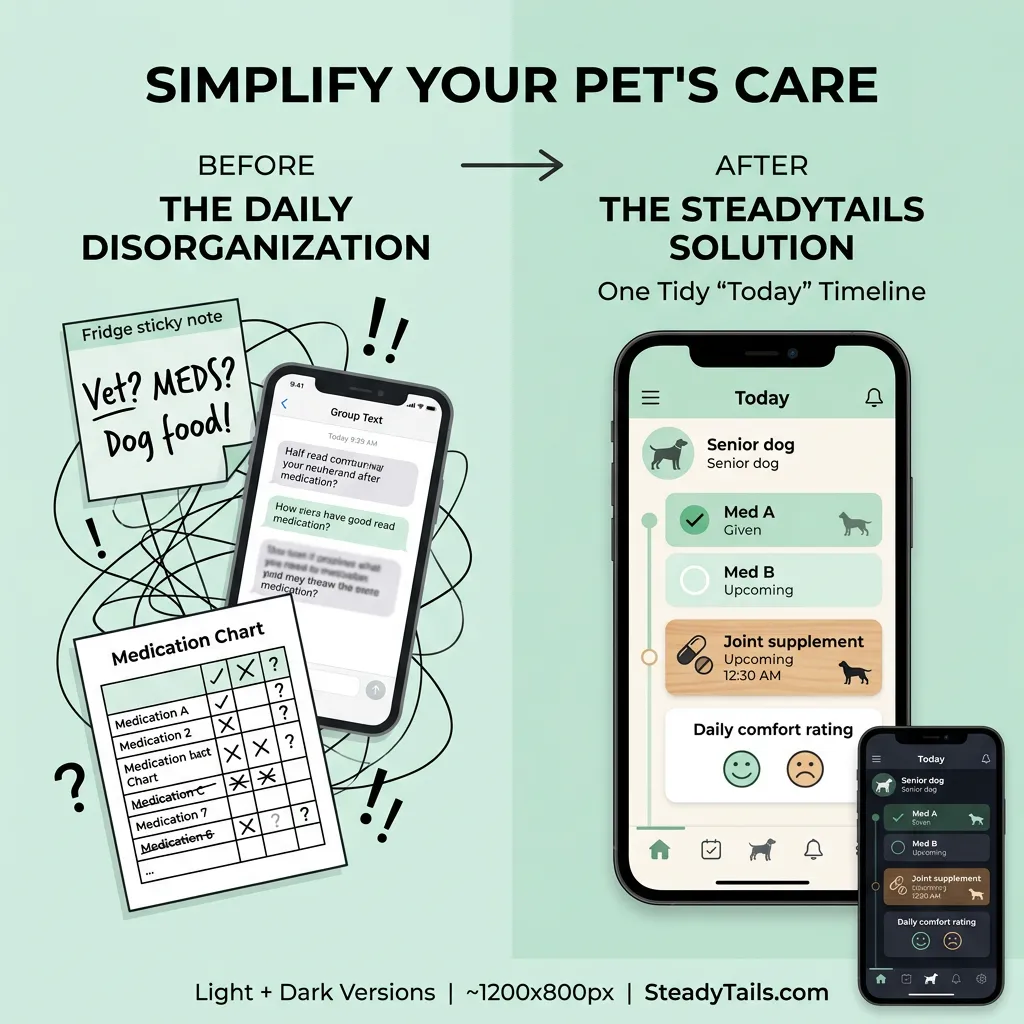
Here's the thread connecting everything above: senior care is rarely one medication or one person. It's a renal diet and a phosphate binder and a joint supplement and a daily comfort check — often handled by a partner, an adult child, and the occasional pet sitter. That combination of polypharmacy and multiple caregivers is exactly where things slip: a dose given twice because two people each thought the other forgot, or a symptom no one connected because the observations lived in three different phones.
The fix isn't more willpower — it's one shared source of truth. That's what SteadyTails is built for: a household timeline where a dose logged on one phone instantly updates everyone, reminders that suppress across all devices once care is marked given (so no accidental double doses), daily wellness ratings that reveal trends over weeks, and a clean, exportable vet-ready PDF report so your next appointment runs on data instead of memory.
If your senior pet is managing a specific condition, these companion guides go deeper:
- Why pets miss medication doses — and the household system that fixes it — the research on why roughly half of doses slip, and how to build a system that doesn't rely on memory.
- Tracking insulin shots for a diabetic dog — 12-hour timing, food coordination, and preventing hypoglycemic double doses.
- Managing strict seizure medication intervals — keeping anti-epileptic drug levels steady on 8- and 12-hour schedules.
- What to log for a cat with chronic kidney disease — fluids, appetite, and nausea tracking that builds a genuinely vet-ready history.
- How to avoid double dosing your pet's medication — the shared-household safeguards that stop the most common at-home medication emergency.
The bottom line
Your pet's senior years don't have to be a slow series of things you missed. Most of what looks like "just getting old" is something you can monitor, manage, and often improve — if you catch it early and keep good records. Twice-yearly exams, a steady daily routine, and a shared system that everyone in the household can see turn aging from something that happens to your pet into something you navigate together, calmly.
Give your senior pet's care a single source of truth
Coordinate every medication, supplement, and daily observation across your whole household — with reminders that prevent missed and doubled doses, wellness trends that surface problems early, and a vet-ready PDF you can hand over at your next visit. SteadyTails is coming soon to iOS and Android — reserve your spot free.
Join the SteadyTails waitlist →References
- American Animal Hospital Association. 2023 AAHA Senior Care Guidelines for Dogs and Cats. aaha.org/senior-care
- American Veterinary Medical Association. AAHA releases new guidelines on care of senior dogs, cats. avma.org
- Prevalence of osteoarthritis in the shoulder, elbow, hip and stifle joints of dogs older than 8 years. The Veterinary Journal, 2024. LMU Munich open-access PDF
- Anderson KL, et al. Prevalence, duration and risk factors for appendicular osteoarthritis in a UK dog population under primary veterinary care. Scientific Reports, 2018. nature.com/articles/s41598-018-23940-z
- Osteoarthritis in cats: what we know, and mostly, what we don't know yet. PMC, 2024. pmc.ncbi.nlm.nih.gov/articles/PMC12277680
- Evaluation of cognitive function in the Dog Aging Project. Scientific Reports, 2022; and physical signs of canine cognitive dysfunction, PMC. nature.com/articles/s41598-022-15837-9
- Survey reveals cat and dog owners are mistaking osteoarthritis pain for normal signs of aging (Zoetis-commissioned survey); see also Morris Animal Foundation, What pet owners need to know about osteoarthritis. morrisanimalfoundation.org