

You sit down in the exam room, the vet asks "so what's been going on?", and your mind goes blank. Was the limping the left leg or the right? When did the appetite drop off — last week, or three weeks ago? Did your partner give the morning pill or not? By the time you get home, half of what the vet told you has already evaporated. If that sounds familiar, you're not disorganized — you're normal. And a little preparation fixes almost all of it.
This guide is a complete, research-backed checklist for getting the most out of every veterinary appointment, whether it's a routine annual exam or a worrying new symptom. You'll learn exactly what to bring, the right questions to ask for each kind of visit, how to keep your dog or cat calmer on the way there, and how to make sure the plan actually sticks once you're home.
Key takeaways
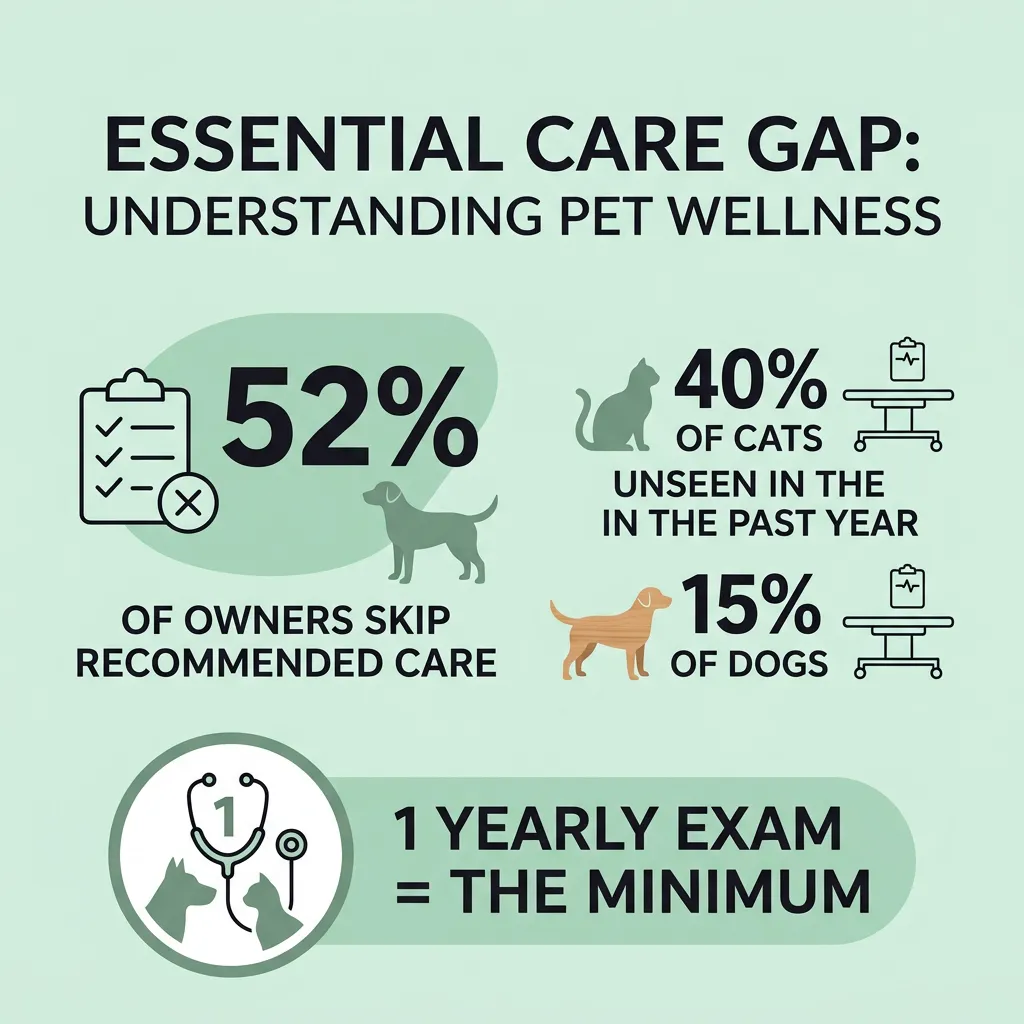
- Care often gets skipped. A 2024 Gallup study found 52% of U.S. pet owners had skipped or declined recommended veterinary care — and among those who did, 14% said their pet's condition worsened or it died.¹
- Cats are underserved. 40% of cats hadn't seen a vet in the past year, versus 15% of dogs, largely because of carrier and travel stress.²
- Information overload is real. Owners are flooded with verbal instructions and handouts during a stressful visit and frequently lose track of the details afterward.⁵
- Annual is the floor, not the goal. Leading guidelines say every dog and cat should be examined at least once a year, more often for seniors and chronic conditions.⁴
Why does preparing for the vet actually matter?
It's easy to treat a vet visit as something that happens to you — you show up, the vet does their thing, you leave. But the research tells a different story: how prepared the owner is shapes whether problems get caught, whether the plan gets followed, and sometimes whether the pet gets seen at all.
- A lot of recommended care never happens. In a 2024 Gallup survey of nearly 2,500 dog and cat owners, 52% had skipped or declined veterinary care at some point. The most commonly declined items were diagnostics and preventive care — exactly the things that catch disease early.¹
- Cats slip through the cracks. The landmark Bayer Veterinary Care Usage Study found 40% of cats had not been to a veterinarian in the previous year, compared with 15% of dogs, and identified "feline resistance" — the hiding, the fight to get into the carrier, the stressful car ride — as a leading reason owners delay.² Fewer than half of cats receive a routine annual wellness exam at all.³
- We forget what we're told. Qualitative research on vet–client communication shows owners are often overwhelmed during the visit, leave with a stack of handouts where the crucial point gets lost, and wish they could revisit the information once they've calmed down.⁵ A patient who's anxious in the waiting room makes it even harder to absorb a treatment plan.
- Pets hide illness, and they age fast. Because dogs and cats instinctively mask weakness, the annual (or twice-yearly) exam is frequently the first opportunity to catch a developing problem. That's why the AAHA–AVMA Preventive Healthcare Guidelines set at least one exam per year as the minimum standard for every dog and cat.⁴
The throughline is simple: the value you get from an appointment is capped by the quality of the information you bring in and how well you capture what comes out. Both are completely within your control.
What should you bring to a vet visit?
Spend ten minutes the day before, and you'll walk in with everything your vet needs to make good decisions. Here's what to gather:
| What to bring | Details & why it matters |
|---|---|
| Medication & supplement list | Every drug and supplement with exact dose, strength, and timing, including flea/tick and heartworm preventives. Note any missed doses honestly — it's clinical information, not a confession. (See why pets miss doses.) |
| Symptom & change history | Shifts in appetite, thirst, weight, energy, sleep, toileting, mobility, or behavior since the last visit — and roughly when each started |
| Wellness trends | Daily logs of appetite, comfort, and energy; patterns over time are what a 15-minute exam can't reveal |
| Diet details | Brand, formula, how much, how often, plus treats, table food, and dental chews |
| Prior records or test results | For a new clinic or specialist: vaccination history, recent bloodwork, imaging, or discharge notes |
| A fresh sample (only if asked) | Stool or urine, collected as close to the appointment as possible; check when you book |
| Payment or insurance info | Keeps cost talk from derailing the medical one; financial concerns drive most declined care¹ |
| The right carrier, leash, or harness | For cats especially, a carrier your pet is already comfortable with (see the stress section below) |
| Your written questions | Written down (next section) so nothing gets forgotten in the moment |
Walk in with the whole story, not a guess
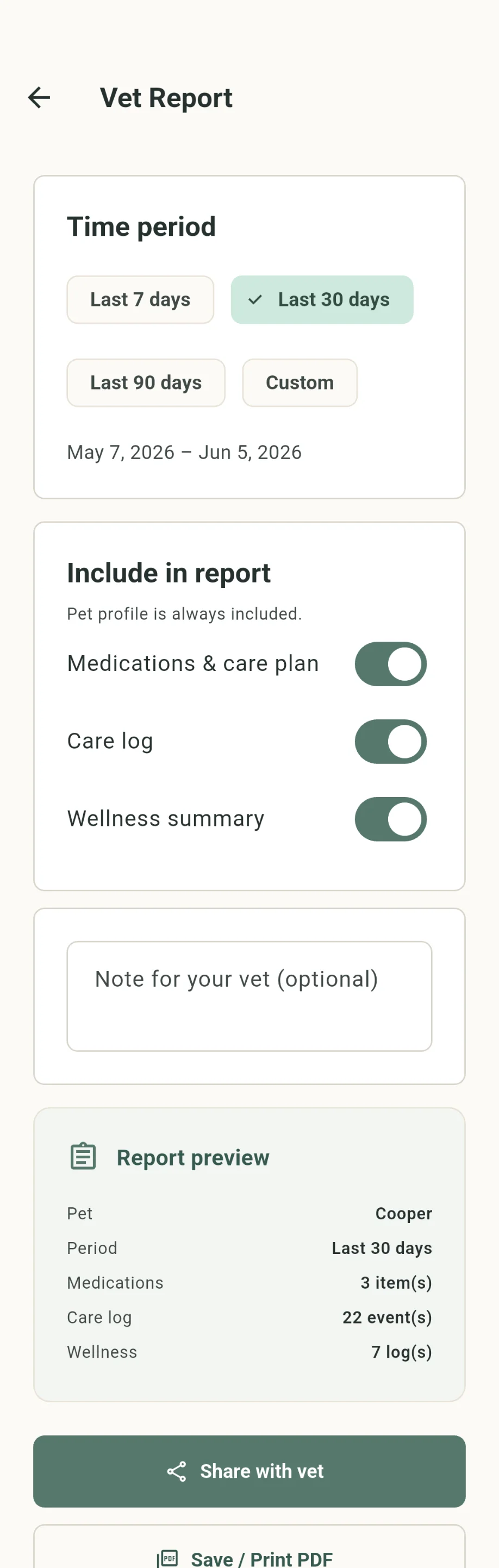
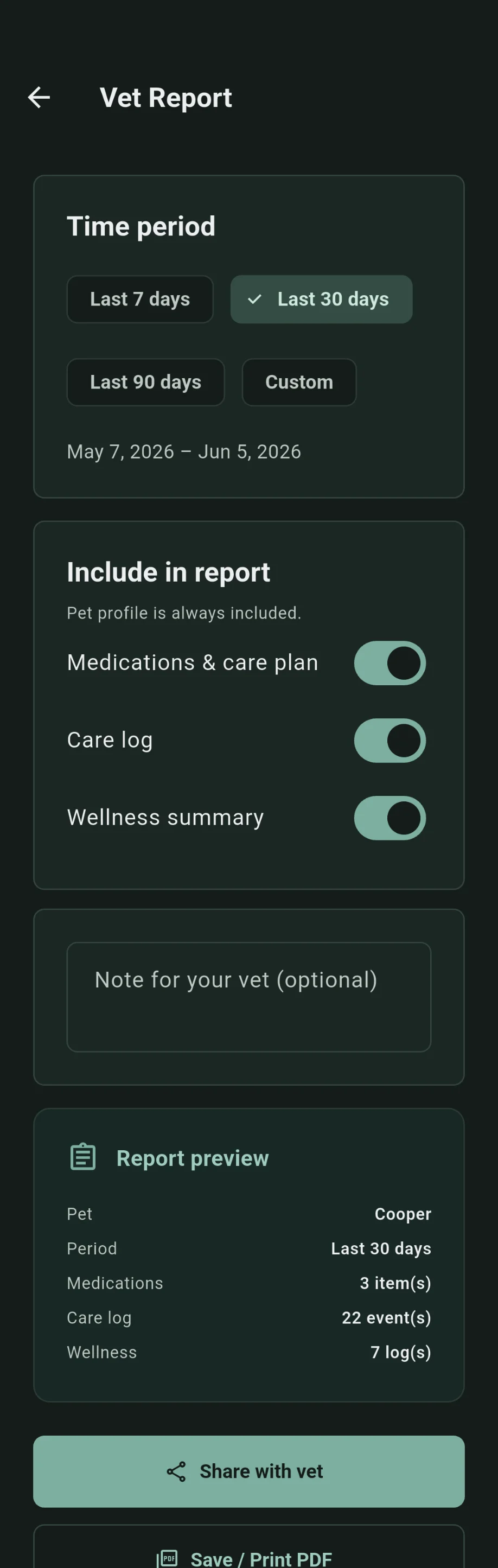
SteadyTails logs every dose and daily wellness signal as it happens, then exports a clean, vet-ready PDF — so you hand your vet real data instead of trying to remember it. Join the waitlist for early access on iOS and Android.
Join the SteadyTails waitlist →What questions should you ask your vet?
Good questions are how you turn a quick exam into a clear plan. Pick the set that matches your visit, and write the answers down before you leave the room.
For a routine wellness exam
- Is my pet's weight and body condition where it should be? If not, what's the target and the plan?
- How do the teeth and gums look — is a dental cleaning due?
- Are we up to date on the right vaccines and parasite prevention for our lifestyle and region?
- Given my pet's age and breed, is any baseline bloodwork or screening worth doing now?
- Is there anything you'd like me to watch for and track before the next visit?
For a new diagnosis
- What exactly is this condition, in plain terms, and what's likely causing it?
- What does the treatment plan look like, and what's the timeline for improvement?
- What side effects or warning signs should make me call you — and what counts as an emergency?
- What's the realistic outlook, and how will we measure whether the treatment is working?
- Are there options at different price points, and what happens if we wait?
For an ongoing chronic condition
- Based on what I've been tracking, are we trending in the right direction?
- Should any dose or schedule change — and if so, exactly how?
- What's the most important thing for me to monitor at home between visits?
- When should the next recheck or lab test be?
This is where condition-specific habits pay off. Our guides on tracking insulin shots for a diabetic dog and what to log for a cat with chronic kidney disease walk through the exact data that makes these conversations productive.
For a senior pet
- Are there age-related changes — kidney, heart, thyroid, joints, cognition — we should screen for now?
- Is my pet in any pain I might be missing? (Subtle stiffness and reduced jumping often signal arthritis.)
- Should we move to twice-yearly exams?
Our senior dog and cat care checklist and guide to spotting and tracking arthritis cover what to monitor between visits.
For any new medication
- What's the exact dose, and how often — and with or without food?
- What should I do if I miss a dose? (Never double up to "catch up" without explicit guidance.)
- What side effects are normal, and which ones mean I should call?
- How and when will we know it's working?
If giving the medication is the hard part, our step-by-step guide on how to give a dog or cat a pill without the fight covers techniques worth asking your vet to demonstrate.
During the visit: capture the plan
The exam room is noisy, fast, and — if your pet is anxious — emotionally distracting. That's precisely why details slip away afterward.⁵ A few habits keep the plan intact:
- Take notes as you go, or record a quick voice memo with permission. Don't trust memory in a stressful room.
- Repeat dosing instructions back out loud. "So that's one tablet twice a day, with food, for ten days?" Saying it confirms it and catches misunderstandings on the spot.
- Ask for the key points in writing. A short written summary or printout dramatically improves how well instructions are followed.⁵
- Clarify the follow-up. When's the next recheck? What result are we hoping for? What would make you want to see my pet sooner?
How do you reduce visit stress, especially for cats?
A calmer pet is easier to examine, gives more reliable findings, and is more likely to keep getting the care it needs. The carrier is the crux for cats: in the Bayer study, only 18% of cat owners had ever received any guidance on making the trip less stressful,³ even though carrier stress is a top reason cats go unseen. A few low-effort changes help a lot:
- Leave the carrier out at home for days or weeks beforehand so it becomes ordinary furniture rather than a once-a-year ambush. Toss treats and a familiar blanket inside.
- Make the carrier smell like home — a worn T-shirt or a blanket from your pet's favorite spot.
- Try a synthetic pheromone spray in the carrier ahead of time, and cover it with a towel during travel to reduce visual stress.
- Ask your clinic about low-stress options — cat-only appointment hours, a separate waiting area, or Fear Free–style handling.
- For anxious dogs, a brisk walk beforehand, a favorite toy, high-value treats, and asking about a quieter appointment time all help.
How do you make the plan stick after the visit?
The appointment is only worth what happens in the weeks that follow. Close the loop the same day:
- Log any new medication immediately — drug, dose, timing — and set reminders so the schedule starts on the right foot.
- Share the update with every caregiver. In a shared household, a new medication or instruction that lives in only one person's head is a missed dose waiting to happen. One shared, real-time record keeps everyone aligned and prevents the dreaded accidental double dose.
- Start tracking what your vet asked you to watch, so your next visit begins with data instead of a shrug.
- Book the follow-up before you forget. If a recheck is due in three weeks, schedule it now.
Important medical disclaimer: SteadyTails is a tracking and coordination tool. It does not provide veterinary advice, diagnosis, treatment, or dosing recommendations. The questions and checklists here are general starting points — always follow the specific guidance of your own licensed veterinarian.
The bottom line
Half of pet owners skip recommended care, a third of cats go a whole year without being seen, and almost everyone forgets part of what the vet said. None of that is about caring less — it's about walking in unprepared and walking out without a way to hold onto the plan. Ten minutes of prep and one shared record flips all of it: you arrive with the real story, ask the right questions, and leave with a plan that actually survives the drive home.
Turn every vet visit into your most useful one
Log doses and wellness in one tap, keep every caregiver in sync, and export a vet-ready history whenever you need it. SteadyTails is coming soon to iOS and Android — reserve your spot free.
Get early access →References
- Gallup. 52% of U.S. Pet Owners Have Skipped or Declined Veterinary Care. 2024. news.gallup.com/poll/659057
- Volk JO, Felsted KE, Thomas JG, Siren CW. Executive summary of the Bayer veterinary care usage study. JAVMA, 2011;238(10):1275–1282. avmajournals.avma.org
- Volk JO, et al. Executive summary of phase 3 of the Bayer veterinary care usage study (Feline Findings). JAVMA, 2014;244(7):799–802. gwern.net/doc/cat/psychology/2014-volk.pdf
- American Animal Hospital Association & American Veterinary Medical Association. AAHA-AVMA Canine & Feline Preventive Healthcare Guidelines. aaha.org/preventive-healthcare-guidelines
- Janke N, et al. Pet owners' and veterinarians' perceptions of information exchange and clinical decision-making in companion animal practice. PLOS ONE / PMC, 2021. pmc.ncbi.nlm.nih.gov/articles/PMC7850489