

Your dog can't tell you when something hurts. Worse, they're built to hide it — an instinct so strong that a dog with real, treatable pain will still wag at the door, clean their bowl, and curl up like nothing's wrong. So the hardest part of loving an ageing or unwell dog isn't the big, obvious crisis. It's the quiet, gradual slide that's almost impossible to see from the inside.
This guide is about learning to see it. We'll cover the subtle behavioural signs of pain in dogs, how veterinarians actually measure quality of life, and — most importantly — how to track the trend at home so a slow decline doesn't stay invisible until it's advanced. None of this replaces your vet. It just helps you walk in with something better than a gut feeling.
Key takeaways
- Dogs mask pain by instinct. The first signs are behavioural and quiet — less mobility, more sleep, subtle withdrawal — not whimpering.
- Comfort matters more than age. Ask whether pain is controlled, appetite holds, and good days outnumber bad — not just "how old is my dog?"
- Vets use structured scales. On the HHHHHMM scale (7 factors, 0–10 each), a total above 35 of 70 suggests quality of life is acceptable enough to continue comfort care.¹
- One score is a snapshot; the trend is the story. Re-scoring on a set interval turns a gradual slide into something you can actually see — and act on early.
How can you tell if your dog is in pain?
The most reliable signs of pain in dogs are behavioural, and they're usually subtle. Because dogs instinctively hide weakness, they rarely cry out until pain is severe. Instead, watch for a cluster of small changes: reluctance to jump, use stairs, or rise after resting; more sleeping and less play; reduced grooming; a hunched back or tucked posture; panting at rest; or licking and chewing at one spot.
Temperament shifts matter too. A dog in chronic discomfort may become withdrawn, clingy, or unusually irritable — a shorter fuse around other pets or being handled. None of these is proof on its own. But two or three appearing together, or a familiar behaviour quietly disappearing, is worth taking seriously. The pattern is the signal, not any single moment.
This is exactly why arthritis and other chronic conditions go undertreated for so long. Owners expect limping; what they get is a dog who's simply "slowing down with age." For how to catch and monitor that specific pattern, see our guide on spotting and tracking arthritis in dogs and cats.
What quietly signals that a dog's quality of life is slipping?
Quality of life isn't a single thing — it's the balance of several. Veterinarians break it into concrete factors so nothing important gets overlooked, and the same framework works at home. The widely used HHHHHMM scale, developed by veterinary oncologist Dr. Alice Villalobos, tracks seven of them.¹ Reframed as everyday questions, they are:
- Hurt. Is pain controlled, and can your dog breathe easily? Comfort and easy breathing come first.
- Hunger. Is your dog eating willingly and keeping food down, or do you need to coax every meal?
- Hydration. Are they drinking enough, or does hydration need help (for example, vet-directed fluids)?
- Hygiene. Can your dog be kept clean and dry — no soiling, matting, or pressure sores?
- Happiness. Do they still show interest — greeting you, wagging, engaging with favourite people or toys?
- Mobility. Can they get up, walk, and toilet, with or without help like a sling or harness?
- More good days than bad. Over a week, do the good days clearly outnumber the ones dominated by pain, nausea, or distress?
Read together, these turn a vague worry into something specific. A dog can score well on mobility but poorly on appetite, or the reverse — and knowing which factor is slipping tells you exactly what to raise with your vet, who can often improve it. If your dog is also a senior, our senior pet care checklist pairs well with this as a daily routine.
Why one bad day isn't the answer — track the trend
Here's the trap: quality of life changes so gradually that any single day tells you almost nothing. A dog can have a rough morning and a bright evening; you can catch them on their worst hour or their best. Judged one day at a time, decline hides in the noise. That's why the most important word in this whole subject is trend.
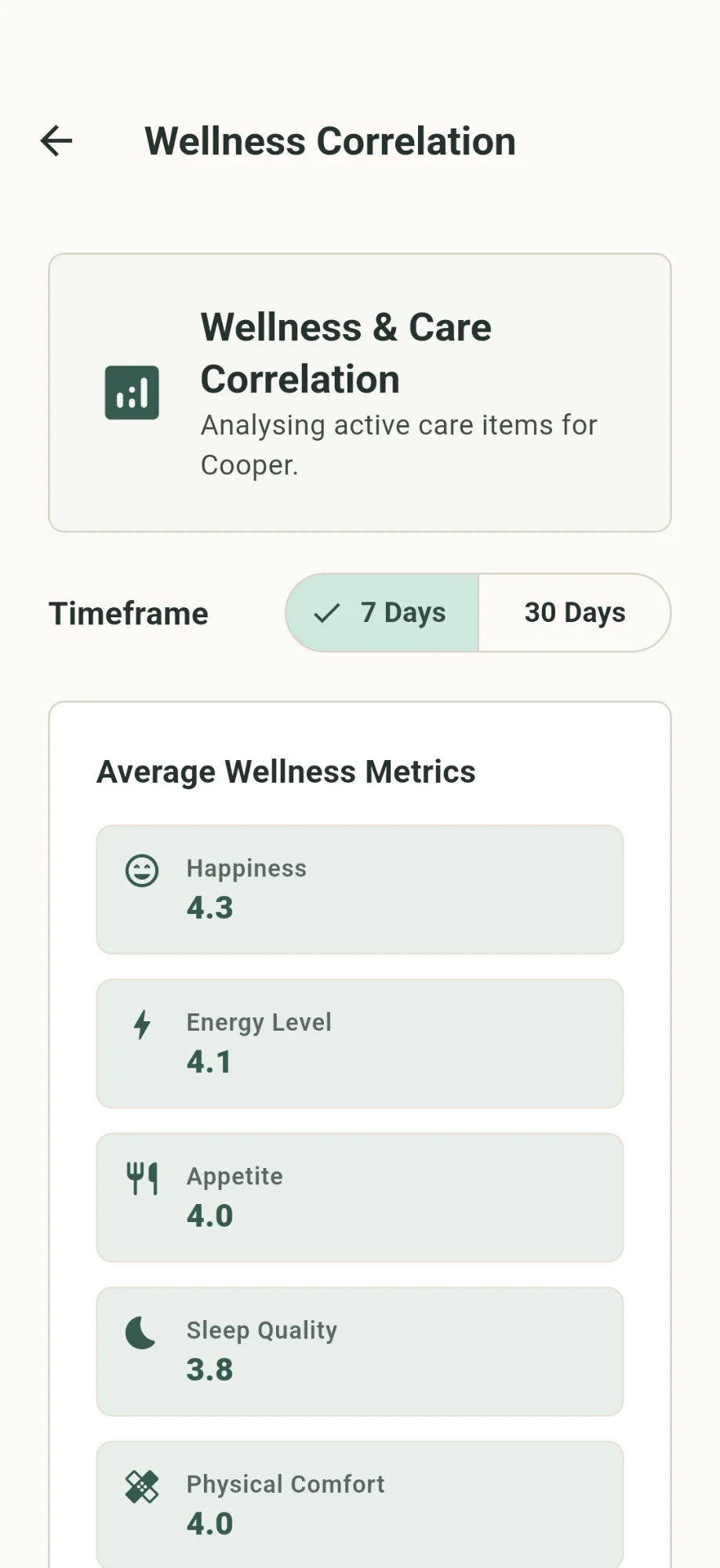
Score the same factors on a set interval — weekly for a stable senior, every few days during a decline — and something powerful happens. A number that drifts from 48 to 44 to 39 over three weeks is telling you a story you'd never notice day to day. The point isn't the individual score. It's the direction of travel, caught early enough to do something about it with your vet.
Doing this on paper works, but it's easy to let slip. Logging comfort and mobility in one place — where the whole household can add what they see and the trend draws itself — makes a slow slide visible instead of invisible.
Hurt
Is pain managed? Can your dog breathe easily? Adequate pain control — including the ability to breathe without effort — is the first priority.
How do vets actually measure a dog's quality of life?
Veterinarians rely on structured, published scales rather than a single impression — and the two best known are freely available for owners to use. On the HHHHHMM scale, each of the seven factors is scored from 0 to 10 for a total out of 70; Dr. Villalobos' published guidance is that a total above 35 suggests quality of life is acceptable enough to continue supportive care.¹
The second is the JOURNEYS scale, developed by Dr. Katie Hilst.² It scores eight areas — including one many owners overlook: you, the caregiver's own time, finances, and emotional capacity. JOURNEYS publishes no fixed cutoff on purpose; it's designed to track change over time and to make honest space for the caregiver's limits, which are a legitimate part of the picture.
Both scales exist to do the same thing: replace a swirl of worry with something you can measure, repeat, and hand to your vet. Our dog quality of life calculator implements both, so you can pick whichever fits your situation — or run both and compare.
When is it time to talk to your veterinarian?
No score decides this, and no article should. But some signs mean the conversation shouldn't wait. Reach out to your vet promptly if you notice persistent, poorly-controlled pain or laboured breathing; refusal to eat or drink; a loss of mobility that stops your dog toileting with dignity; or — the signal that matters most — bad days that have started to outnumber the good.
Having that conversation early isn't giving up; it's the opposite. Vets and services like Lap of Love can often introduce comfort options owners didn't know existed — pain protocols, anti-nausea support, mobility aids, and, when the time comes, gentle end-of-life care.³ Walking in with a few weeks of scores turns a painful, abstract decision into a grounded, shared one. If a visit is on the horizon, our vet visit preparation checklist shows exactly what to bring.
Important medical disclaimer: SteadyTails is a logging and coordination tool. This guide is for general reference and does not provide veterinary advice, diagnosis, or treatment. Quality-of-life scales support your decisions — they don't make them. Always talk with your veterinarian, who can weigh any score against your dog's specific diagnosis and comfort options.
Keep the whole picture in one place
SteadyTails lets every caregiver log comfort, mobility, appetite, and medication in one shared timeline — so the trend is visible to everyone and your vet history is ready when you need it. Coming soon to iOS and Android; reserve your spot free.
Join the SteadyTails waitlist →References
- Villalobos AE. Quality of Life Scale (HHHHHMM) for pets at the end of life. Via VCA Animal Hospitals. vcahospitals.com Retrieved 2026-07-04.
- Hilst K. JOURNEYS Quality of Life Scale. mnpets.com (PDF) Retrieved 2026-07-04.
- Lap of Love Veterinary Hospice. How Will I Know It's Time? Quality of life resources. lapoflove.com Retrieved 2026-07-04.