

Your senior cat is eating like a teenager — emptying the bowl, yowling for more — and somehow getting thinner. Maybe she's restless at 3 a.m., drinking more, or her coat looks unkempt for the first time in years. Then the bloodwork comes back and the vet says a word you've heard but never had to think about: hyperthyroidism. Now there's a tiny pill to give twice a day, every day, and a quiet new worry in the house — "wait, did anyone give the morning dose?"
If this is you, take a breath. Feline hyperthyroidism is one of the most manageable serious diagnoses in cats, and the medication that treats it — methimazole — works reliably when it's given consistently. This guide explains what the condition is, how methimazole actually works, why the timing of each dose matters more than most owners realize, what your vet will monitor, and how to build a simple household system so a dose never slips through the cracks.
Key takeaways
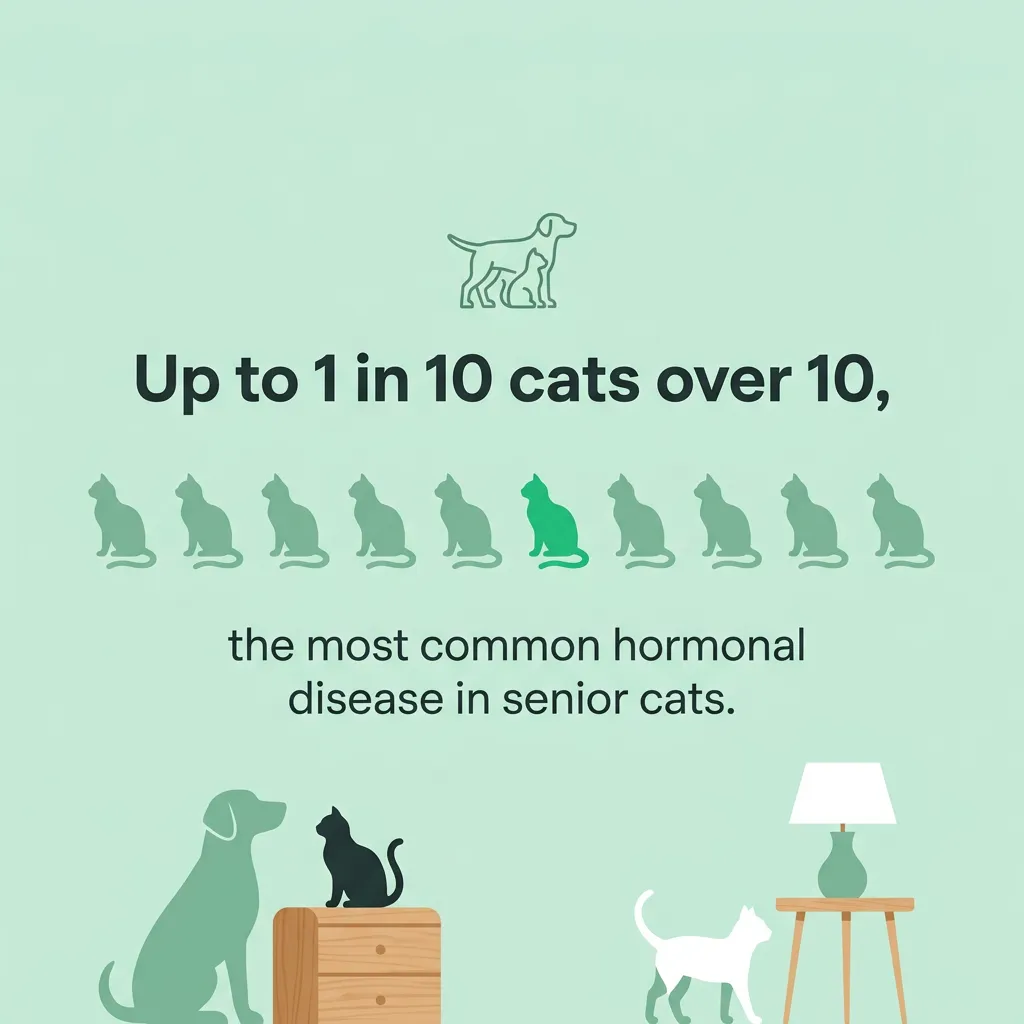
- It's common in older cats. Hyperthyroidism is the most common endocrine disease in senior cats, affecting up to roughly 10% of cats over 10 years old.²
- Methimazole controls, it doesn't cure. It must be given daily for life — it manages the overactive thyroid rather than fixing it.¹
- Twice-daily beats once-daily. About 87% of cats reached normal thyroid levels at two weeks on twice-daily dosing, versus only 54% on the same dose given once daily.³
- The first three months need close monitoring. Most side effects and dose adjustments happen early, so vet rechecks are frequent at the start.¹⁶
- Consistency is the whole game. Steady every-12-hour timing plus a shared log that prevents missed and double doses is the practical key to good control.
What is hyperthyroidism in cats?
Hyperthyroidism happens when the thyroid glands in a cat's neck become overactive and pump out too much thyroid hormone. In the vast majority of cases the cause is a benign (non-cancerous) overgrowth of thyroid tissue, not cancer.¹ Thyroid hormone sets the body's metabolic "speed," so when there's too much of it, everything runs too fast at once.
The classic signs build gradually, which is why they're easy to miss in a cat you see every day:
- Weight loss despite a strong — even ravenous — appetite. This is the hallmark sign.
- Increased thirst and urination.
- Restlessness, irritability, or yowling, especially at night.
- An unkempt, greasy, or matted coat.
- Occasional vomiting or diarrhea.
- A fast heart rate, which your vet may detect at an exam.
Diagnosis is usually straightforward — a blood test measuring total thyroxine (total T4) confirms most cases. Catching it earlier matters: a large cross-sectional analysis of more than 2,000 cats found that the degree of thyroid pathology increases the longer the disease goes untreated.⁷ In other words, the sooner you and your vet get the hormone levels back under control, the better.
How does methimazole work, and why does timing matter so much?
Methimazole (sold as brands such as Felimazole, and also compounded) is the most widely used treatment.⁶ It works by blocking the thyroid gland's ability to produce thyroid hormone. That's the crucial thing to understand: it doesn't shrink the gland or remove the problem — it simply keeps hormone production suppressed for as long as the drug is in the system. The moment levels of the drug fall, the overactive gland starts ramping hormone production back up.
This is exactly why daily, consistent dosing isn't optional and why the schedule matters as much as the dose. Most cats start at around 1.25 to 2.5 mg per cat every 12 hours.³ When researchers compared the same daily amount given as one dose versus split into two, the difference was striking: roughly 87% of cats given methimazole twice daily reached normal thyroid levels within two weeks, compared with just 54% of cats given it once daily.³ Splitting the dose keeps drug levels steadier across the full 24 hours, so the thyroid never gets the long uncontrolled window that a single daily dose allows.
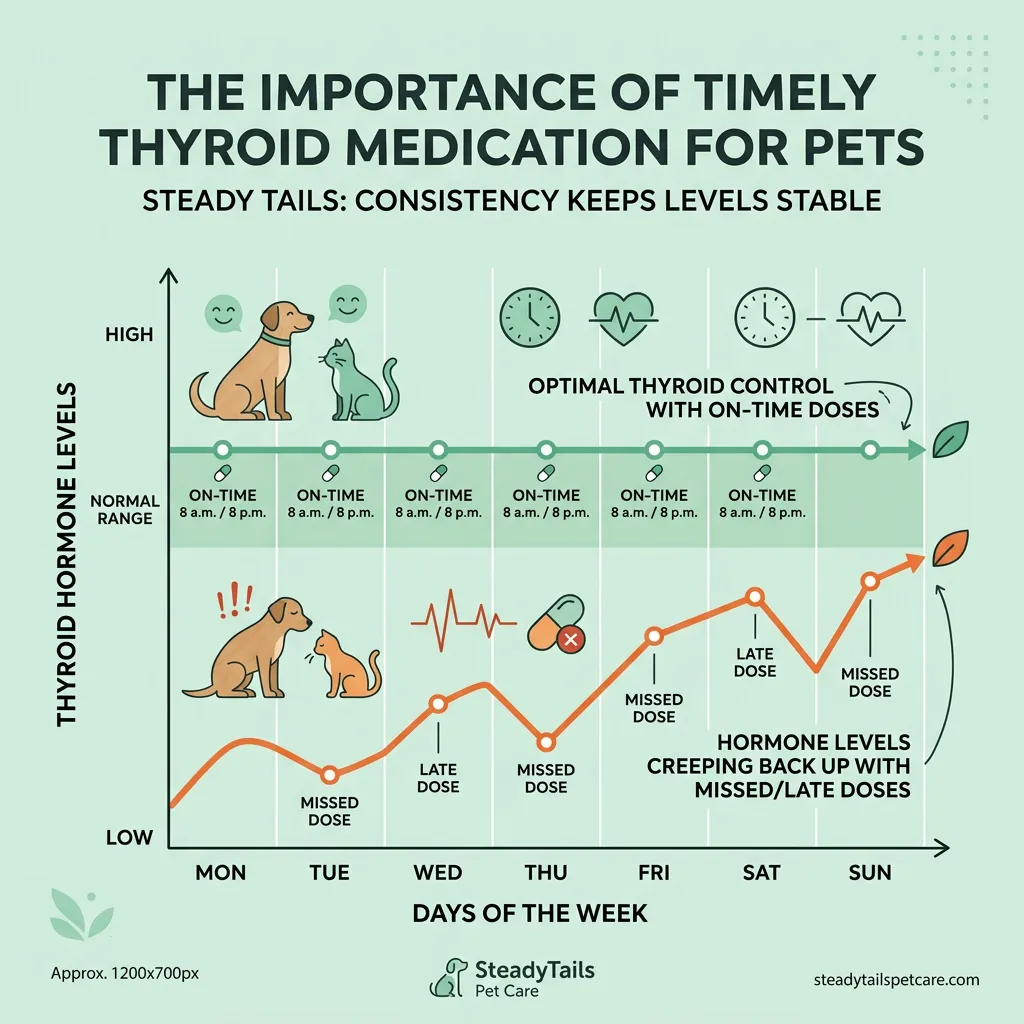
The practical takeaway: a dose that's hours late — or skipped because each caregiver thought the other had handled it — isn't a harmless slip. It lets hormone levels drift back up and works against the steady control you and your vet are trying to maintain.
What about the transdermal gel?
For cats who simply won't take a pill, many vets can prescribe methimazole compounded into a gel that's rubbed onto the inner ear flap (the pinna). Studies show the transdermal route causes fewer gastrointestinal side effects than the oral form — in one study only 1 of 27 cats on the gel had GI upset versus 4 of 17 on tablets.⁴ The trade-off is that it tends to control levels a little more slowly at first; significantly more cats on oral methimazole were in the normal range at two weeks, though the gap closed by four weeks.⁴ It's a great option for fractious cats — worth asking your vet about — but it follows the same rule: applied consistently, twice a day.
What will your vet monitor in the critical first three months?
Starting methimazole isn't "set and forget." The early weeks are about dialing in the right dose and watching for the rare but real side effects. Following published guidelines, vets typically recheck a cat's total T4 every two to four weeks until levels are stable, then less often once the cat is well controlled.¹
An important nuance: the goal is to land the T4 in the lower half of the normal range — not below it. Pushing levels too low (causing hypothyroidism) has been linked to faster progression of kidney disease and worse outcomes, so "more suppression" is not better.¹ Your vet will also run periodic bloodwork — a complete blood count, chemistry panel, and urinalysis — to catch uncommon effects on the bone marrow or liver and to watch the kidneys.¹
At home, you're the early-warning system. Most side effects appear in the first three months,⁶ so keep an eye out for:
- Facial itching or scratching around the head and neck (sometimes severe enough to break skin).
- Vomiting or reduced appetite.
- Lethargy or unusual weakness.
- Any new bruising, pale gums, or yellowing — call your vet promptly.
| When | Test / check | What the vet looks for |
|---|---|---|
| Baseline (start) | Total T4, CBC, chemistry, urinalysis | Confirm diagnosis; baseline kidney, liver, and blood-cell values |
| Every 2–4 weeks (first 3 months) | Total T4 | Dial in the dose; aim for the lower half of the normal range, not below¹ |
| First 3 months | CBC + chemistry; watch at home | Rare bone-marrow or liver effects; facial itching, vomiting, appetite⁶ |
| Once stable | Total T4 + kidney values, less often | Confirm steady control; watch for kidney disease unmasked as thyroid normalizes |
This is where day-to-day logging earns its keep. When you track appetite, energy, weight, and any odd symptoms at home, you walk into each recheck with real data instead of "I think she's been a bit quieter?" That turns a guessing game into a precise conversation — and it's exactly the kind of running record a tool like SteadyTails is built to capture and export.
The hidden link: hyperthyroidism and kidney disease
Here's something many owners aren't told up front: hyperthyroidism and chronic kidney disease (CKD) often travel together in senior cats, and the thyroid problem can actually mask underlying kidney disease. The overactive thyroid increases blood flow through the kidneys, which can make kidney values look better than they really are. When methimazole brings the thyroid under control, that masking effect lifts — and sometimes previously hidden kidney disease becomes visible.¹
This isn't a reason to avoid treatment; uncontrolled hyperthyroidism is harmful on its own. It's a reason that methimazole is often the smart first step — it's reversible, so your vet can treat the thyroid, recheck the kidneys, and only then weigh permanent options like radioiodine. It's also why steady, monitored dosing (avoiding both missed doses and over-suppression) matters so much for these cats. If your cat is juggling both conditions, our companion guide on what to log for a cat with chronic kidney disease walks through the appetite, hydration, and symptom tracking that keeps both teams — yours and your vet's — working from the same picture.
Twice a day, every day, by more than one person
That's exactly where doses slip — one caregiver leaves early, another assumes it's done. SteadyTails keeps everyone on one shared, real-time timeline and suppresses the reminder the moment anyone logs the dose, so your cat's every-12-hour rhythm stays steady. Join the waitlist for early access on iOS and Android.
Join the SteadyTails waitlist →How do you actually give a hyperthyroid cat its pill?
A twice-daily pill in a cat who has opinions can feel daunting — but it's more doable than most owners fear. In one survey, 79% of owners said they were (or would be) happy to dose their cat twice daily to control hyperthyroidism, and for 62% of owners, pilling twice daily was not a problem in practice.⁵ A few things help:
- Ask your vet to demonstrate technique at the start — proper, gentle hand-pilling is a learnable skill, and most owners are never actually shown how.
- Try pill pockets or a small amount of a strong-smelling favorite food, if your vet confirms it's appropriate for the medication.
- Keep it calm and quick. A short, low-drama routine beats a wrestling match — a dreaded chore is a postponed chore.
- If pilling truly won't work, ask about the transdermal gel or a flavored compounded formulation. For fractious cats, the ear-gel option can be the difference between consistent treatment and a daily battle.⁴
For a full, vet-backed walkthrough of food-first methods and safe hand-pilling, see our guide on how to give a dog or cat a pill without the fight.
How do you build a no-missed-dose system at home?
Methimazole's effectiveness depends on consistency, and consistency depends on your system — not your memory. In a busy household, "I'll remember" and a sticky note on the cabinet are the weakest possible safeguards, especially when two or more people share the care. The fix is structural:
- Keep one shared source of truth. Replace memory and group texts with a single record every caregiver can see in real time, so no one has to ask "did you already give it?"
- Log each dose the instant it's given. When a dose is logged immediately, a shared system can suppress the reminder on everyone else's device — preventing both a missed dose and an accidental double dose. Double dosing is the most common at-home medication error; our guide on how to avoid double dosing your pet's medication covers the safeguards in detail.
- Anchor the schedule to a steady 12-hour rhythm (for example 8 a.m. and 8 p.m.) and keep it consistent day to day.
- Track wellness alongside doses. Note appetite, energy, weight, and any side-effect signs so your recheck visits are driven by real data.
- Keep a vet-ready history you can export and bring to every appointment.
This is the same household pattern that prevents missed doses across every chronic condition. If you want the bigger picture on why doses slip and how to fix it system-wide, start with why pets miss their medication doses — and the household system that fixes it.
Important medical disclaimer: SteadyTails is a tracking and coordination tool. It does not provide veterinary advice, diagnosis, treatment, or dosing recommendations. Methimazole dosing, monitoring, and treatment choices must be made by your veterinarian. Never start, stop, change a dose, or double up to "catch up" a missed dose without explicit instructions from your vet.
The bottom line
A hyperthyroidism diagnosis sounds scarier than it usually turns out to be. The condition is common, well understood, and very treatable — and methimazole controls it reliably when it's given consistently. The hard part was never the medicine; it's the logistics of two doses a day, every day, often across more than one caregiver, for the rest of your cat's life.
Swap memory and sticky notes for a shared, real-time system, and the daily "did anyone give it?" anxiety simply disappears — while your cat gets the steady, on-time dosing the research says works best. That's exactly what SteadyTails is built to do.
Keep your cat's twice-daily rhythm rock-steady
Invite every caregiver, log doses in one tap, suppress duplicate reminders automatically, and export a vet-ready history for every recheck. SteadyTails is coming soon to iOS and Android — reserve your spot free.
Get early access →References
- Carney HC, Ward CR, Bailey SJ, et al. 2016 AAFP Guidelines for the Management of Feline Hyperthyroidism. Journal of Feline Medicine and Surgery, 2016;18(5):400–416. PubMed Central (free full text)
- Today's Veterinary Practice. Focus on Pharmacology: Methimazole — Management of Feline Hyperthyroidism. todaysveterinarypractice.com
- Trepanier LA, Hoffman SB, Kroll M, et al. Efficacy and safety of once versus twice daily administration of methimazole in cats with hyperthyroidism. JAAHA / J Am Vet Med Assoc, 2003. pubmed.ncbi.nlm.nih.gov/12685785
- Sartor LL, Trepanier LA, Kroll MM, et al. Efficacy and safety of transdermal methimazole in the treatment of cats with hyperthyroidism. Journal of Veterinary Internal Medicine, 2004;18(5):651–655. pubmed.ncbi.nlm.nih.gov/15515580
- Caney SMA. Owner experiences of treating hyperthyroid cats with transdermal methimazole. PMC. pmc.ncbi.nlm.nih.gov/articles/PMC10822224
- U.S. Food & Drug Administration. Hyperthyroidism in Cats — Two FDA-Approved Drugs Available to Treat It. fda.gov
- Peterson ME, et al. Prevalence and degree of thyroid pathology in hyperthyroid cats increases with disease duration: a cross-sectional analysis of 2096 cats. PMC. pmc.ncbi.nlm.nih.gov/articles/PMC11149013