

Walk down any pet-store aisle or scroll any dog-wellness feed in 2026 and you'll be promised the world: shinier coats, younger joints, calmer nerves, a longer life — all in a chewable treat. The global pet supplement market has ballooned past $2.5 billion, and dogs are the biggest target. But here's the uncomfortable question almost no label answers: does any of this actually work?
We went straight to the peer-reviewed veterinary literature and graded the five biggest dog-supplement trends of 2026 — omega-3s, glucosamine, probiotics, CBD, and the new wave of "longevity" chews — as Fact, Myth, or somewhere in between. No hype, no fear-mongering. Just what the science says, and how to make a smart, safe decision for your own dog.
Key takeaways: the 2026 scorecard
- Omega-3 fish oil — ✅ FACT. The best-evidenced supplement for dogs; high-dose EPA/DHA measurably eases arthritis.¹²
- Glucosamine & chondroitin — ⚠️ MOSTLY MYTH. Trials and a 2022 review show little benefit over placebo — though it's very safe.³
- Probiotics & postbiotics — 🟡 EMERGING FACT. Real benefits for digestive upset, but strain- and situation-specific.⁴
- CBD — ⚠️ OVERHYPED, UNDER-PROVEN. Encouraging owner reports, weak objective data, low overall certainty.⁵⁶
- Longevity / anti-aging chews — 🔬 PROMISING BUT EARLY. One good cognition trial; no proof of a longer lifespan yet.⁷
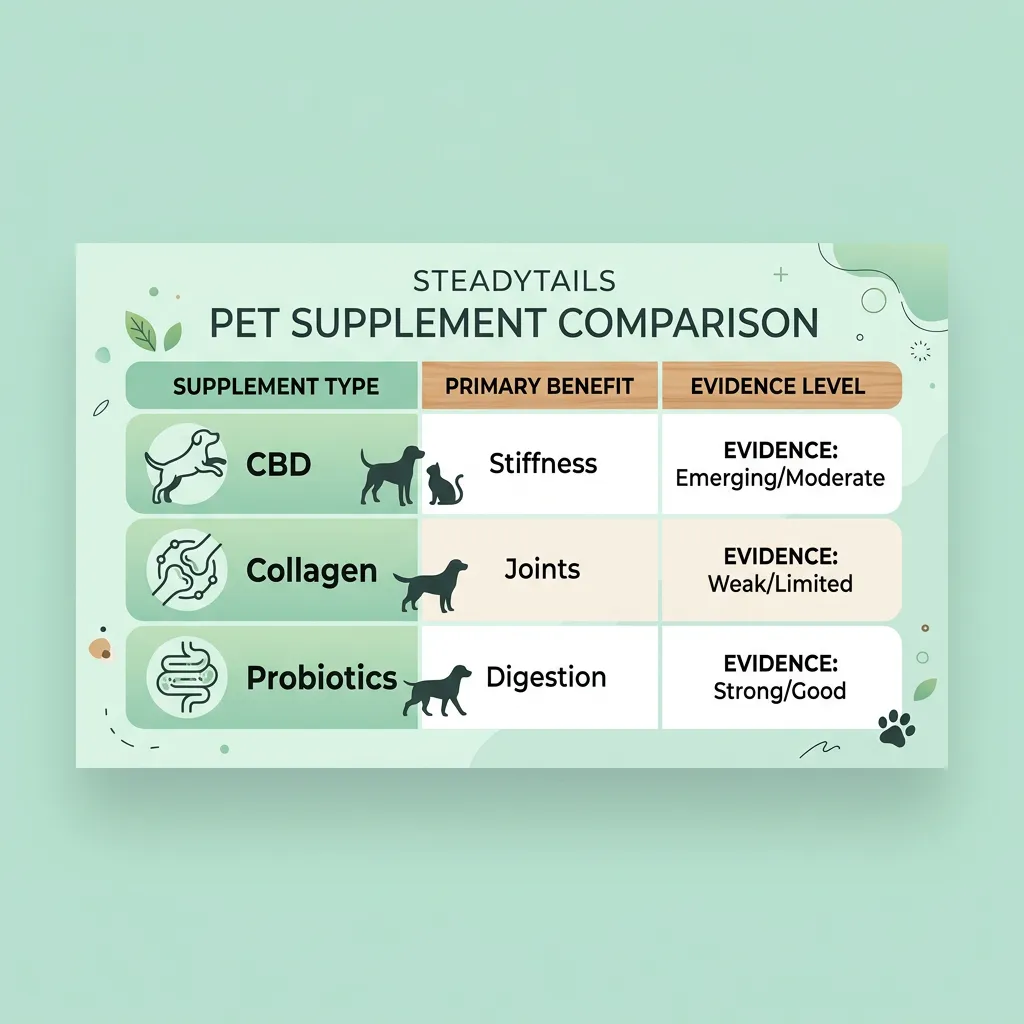
| Supplement | 2026 verdict | Evidence strength | Key source |
|---|---|---|---|
| Omega-3 fish oil (EPA/DHA) | ✅ Fact | Strong — multiple RCTs and a 2022 meta-analysis | JAVMA 2010; 2022 review |
| Glucosamine & chondroitin | ⚠️ Mostly myth | Weak, mixed vs. placebo | 2022 review; VCOT 2017 |
| Probiotics & postbiotics | 🟡 Emerging fact | Moderate, strain- and situation-specific | Sci. Reports 2024 |
| CBD | ⚠️ Overhyped | Low certainty; benefit mostly subjective | Cornell 2018; 2023 meta-analysis |
| Longevity / anti-aging chews | 🔬 Promising, early | Early — one cognition RCT, no lifespan proof | Sci. Reports 2024 |
First, the thing nobody tells you: supplements aren't regulated like medicine
Before we grade a single product, you need this context, because it changes how you read every label. In the United States, dog supplements are not approved by the FDA the way prescription drugs are. No one is verifying, before a product hits the shelf, that the bottle contains what the label claims, in the amount it claims, free of contaminants. Independent testing has repeatedly found supplements — human and animal — that contain far more or far less active ingredient than advertised.
That doesn't mean supplements are useless or dangerous. It means the brand matters as much as the ingredient. Your single best filter is the National Animal Supplement Council (NASC) Quality Seal,⁸ which requires participating companies to meet quality-control and adverse-event-reporting standards. Pair that with brands that publish third-party lab results, and you've eliminated most of the junk before you even evaluate the science. We'll come back to a full buyer's checklist at the end.
Important medical disclaimer: SteadyTails is a tracking and coordination tool, not a veterinary service. This article summarizes published research for general education only — it is not veterinary advice, diagnosis, or a dosing recommendation. Supplements can interact with medications and existing conditions. Always talk to your veterinarian before starting, stopping, or changing anything you give your dog.
1. Omega-3 fish oil — ✅ Fact
The trend: Omega-3s (specifically the marine fatty acids EPA and DHA, usually from fish or krill oil) are pitched for everything from glossy coats to brain health to joint comfort. It's the supplement most likely to already be in your cupboard.
What the science says: This is the one popular supplement with genuinely strong evidence. In two randomized, double-blind, placebo-controlled trials published in JAVMA, dogs with osteoarthritis fed a high omega-3 diet showed significant improvements in weight-bearing and in their owners' and vets' assessments of pain, lameness, and mobility versus controls.¹² A 2022 systematic review and meta-analysis of nutraceuticals for canine and feline osteoarthritis went further, concluding that omega-3-enriched diets had the strongest, most consistent evidence base of anything reviewed — strong enough that some dogs needed less anti-inflammatory medication.³ Beyond joints, omega-3s also have supportive evidence in canine chronic kidney disease and skin conditions.
The catch: Dose and form. The benefits in these trials came from concentrated, therapeutic levels of EPA and DHA — not the trace amounts sprinkled into a general multivitamin chew. If you're buying fish oil for joints, you're buying it for EPA/DHA content, so check the milligrams, not the marketing. And start slowly: the most common side effect is loose stool.
Verdict: ✅ Fact. The best-evidenced supplement on this list. If your dog has arthritis or stiffness, this is the one to discuss with your vet first. (For tracking joint changes over time, see our guide on how to spot and track arthritis in dogs and cats.)
2. Glucosamine & chondroitin — ⚠️ Mostly myth
The trend: The original joint supplement. Glucosamine and chondroitin sulfate are in countless "hip & joint" chews and are often the first thing owners reach for when an older dog slows down.
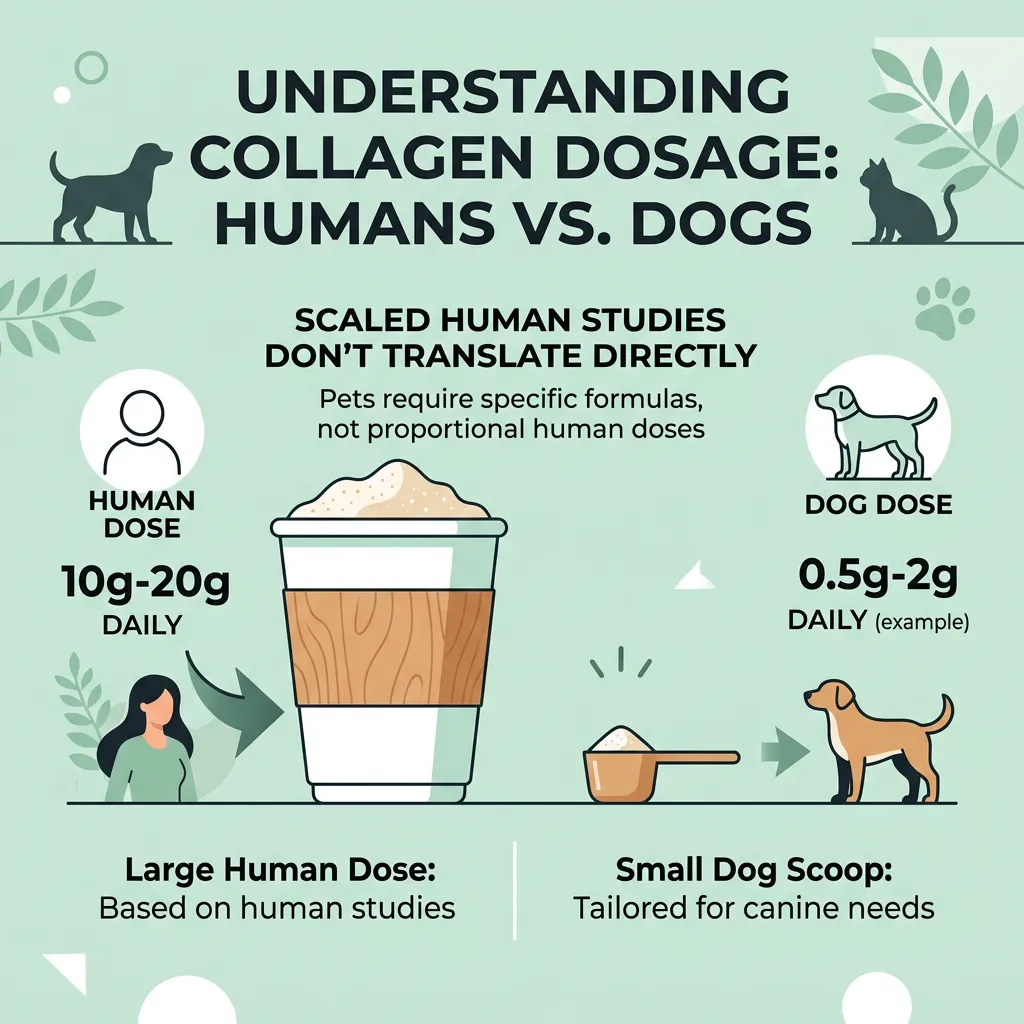
What the science says: Here's where popularity and proof diverge. Despite decades of use, well-designed trials have struggled to show that glucosamine and chondroitin beat a placebo for canine osteoarthritis pain. The same 2022 systematic review that praised omega-3s found the evidence for glucosamine-chondroitin weak and inconsistent, and a randomized controlled trial comparing it head-to-head with other treatments found it did not produce a meaningful clinical improvement.³⁹ Some pain specialists now argue these products should no longer be the default recommendation for managing arthritis pain.
The nuance: Glucosamine and chondroitin are remarkably safe, with very few side effects. Because of that, plenty of vets see little harm in a trial run, and a subset of owners report their dogs do better on it (a response that's hard to separate from placebo effect and natural day-to-day variation). The honest summary: it probably won't hurt, it might not help, and it shouldn't crowd out treatments that actually have evidence.
Verdict: ⚠️ Mostly myth. Not a scam, but oversold. Don't let a joint chew become a substitute for the things that genuinely move the needle on arthritis — weight control, omega-3s, appropriate exercise, and vet-directed pain relief.
3. Probiotics & postbiotics — 🟡 Emerging fact
The trend: Gut health went mainstream for dogs in 2025–2026, and 2026's twist is "postbiotics" — beneficial compounds produced by bacteria, marketed as a more shelf-stable alternative to live cultures.
What the science says: This is a real and fast-growing field, and the evidence is genuinely encouraging — with caveats. Probiotics have the best support for specific digestive situations: shortening bouts of acute diarrhea, easing stress- or antibiotic-related gut upset, and supporting stool quality. Newer randomized controlled trials in 2024 explored strains for everything from gut microbiome balance to weight management in overweight dogs, with measurable effects on fecal quality and the microbiome.⁴ Postbiotic research is earlier but promising.
The catch: Benefits are strain-specific and situation-specific — "probiotics" is a category, not a single product, and a strain proven for diarrhea won't necessarily do anything for a healthy dog's coat or mood. A 2024 review also flagged publication bias in the field, meaning positive results may be over-represented in the literature.¹⁰ Quality control matters enormously, too: a probiotic only works if the organisms are actually alive and present in the numbers claimed — another reason the NASC seal and third-party testing matter.
Verdict: 🟡 Emerging fact. Legitimately useful for the right dog and the right problem (especially digestive upset), but not a magic daily cure-all. Match the strain to the goal, and choose a brand that verifies its counts.
4. CBD — ⚠️ Overhyped, under-proven
The trend: CBD (cannabidiol) oils, chews, and treats remain one of the hottest categories, marketed for arthritis pain, anxiety, noise phobia, and seizures.
What the science says: The picture is more nuanced than either the hype or the skepticism suggests. A frequently cited Cornell University trial reported that a majority of arthritic dogs showed decreased pain and increased activity on CBD based on owner and veterinary assessment.⁵ That's promising. But the more rigorous you get, the softer the signal: studies using objective gait-analysis measurements haven't consistently confirmed the owner-reported improvements, and a 2023 systematic review and meta-analysis concluded the overall certainty of evidence was low, with benefits resting mostly on subjective scoring.⁶ For anxiety and seizures, the evidence is even thinner.
Safety: Reassuringly, short-term CBD use appears well tolerated in dogs. The most common findings are mild — soft stool and a temporary, asymptomatic rise in the liver enzyme ALP. The bigger concerns are drug interactions (CBD can affect how other medications are metabolized) and wildly inconsistent product quality, since this is one of the least-regulated corners of an already-unregulated market.
Verdict: ⚠️ Overhyped, under-proven. Not snake oil, but nowhere near the miracle the marketing implies. If you want to try it for a specific issue like arthritis, do it with your vet, use a brand with third-party testing and a certificate of analysis, and — critically — track whether it's actually helping rather than trusting your memory.
5. Longevity & anti-aging chews — 🔬 Promising but early
The trend: The buzziest category of 2026. A new class of "longevity" supplements built around NAD+ precursors (cellular energy) and senolytics like spermidine and fisetin (compounds that target worn-out "senescent" cells) promises to slow aging itself. It rides the same wave as high-profile efforts to develop actual lifespan-extending drugs for dogs, such as Loyal's LOY-001 program, which reached a notable FDA milestone on the path toward approval.¹¹
What the science says: The most credible data point so far is a 2024 randomized, controlled clinical trial (conducted with North Carolina State University's veterinary college) in which senior dogs given a combination NAD+ precursor and senolytic supplement showed a significant improvement in owner-assessed cognitive function versus placebo.⁷ That's a real, well-designed result and genuinely exciting for the "is my old dog getting foggy?" problem.
The catch: One promising trial is a starting line, not a finish line. No over-the-counter supplement has been proven to extend a dog's lifespan, the cognition findings rely on owner questionnaires, and long-term safety data is still accumulating. The category is moving fast and worth watching — but it's experimental, and it shouldn't displace the unglamorous fundamentals that we know add healthy years: a lean body weight, dental care, regular exercise, mental enrichment, and routine vet visits.
Verdict: 🔬 Promising but early. The most scientifically interesting trend on this list and the one to watch in 2026 — but treat it as cutting-edge, not proven. Decide with your vet, especially for a senior dog. Our senior dog and cat care checklist covers the evidence-backed basics that matter most as dogs age.
Honorable mention: functional mushrooms
Worth a quick word, because they're climbing fast: functional mushrooms (turkey tail, reishi, lion's mane) are marketed for immune and cognitive support. The standout evidence is for turkey tail, whose compound PSP was studied at the University of Pennsylvania in dogs with hemangiosarcoma (an aggressive cancer); dogs on the highest dose had among the longest median survival times reported for the disease.¹² That's a meaningful finding — but it's specific to a serious cancer under veterinary oncology care, not evidence that a daily mushroom chew benefits an otherwise healthy dog. File it under "real science, narrow application."
How to actually choose a dog supplement (the part that matters)
Whatever you're considering, this checklist will keep you out of trouble and out of the marketing weeds:
- Talk to your vet first — every time. Supplements can interact with medications and conditions. Your vet can tell you whether something is worth trying for your dog, and at what dose.
- Demand quality signals. Look for the NASC Quality Seal, published third-party testing, and a brand willing to share a batch certificate of analysis. In an unregulated market, this is non-negotiable.
- Follow the evidence tier. Prioritize supplements with strong trial data (omega-3s) over those with weak or marketing-only support. "Popular" is not the same as "proven."
- Change one thing at a time. Start a single new supplement in isolation so you can actually tell whether it did anything. Stacking five at once tells you nothing.
- Give it a fair trial — then track it. Most supplements need 4–8 weeks to show effects. Write down your start date and log objective markers (stairs, play, stool quality, appetite, stiffness) over time. A dated record is the only honest way to separate a real benefit from hope and natural good days.
That last point is where most supplement decisions quietly fail. Owners try something, life gets busy, and weeks later nobody can actually say whether it helped — so the bottle gets refilled on faith, or a genuinely useful supplement gets abandoned because no one noticed the gradual improvement. The fix is simple: measure it.
Find out what's actually working — don't guess
SteadyTails lets every caregiver log supplements, medications, mobility, appetite, and stool quality in one shared timeline — so you can see the trend over 4–8 weeks and bring real data to your vet, instead of trusting your memory. Join the waitlist for early access on iOS and Android.
Join the SteadyTails waitlist →The bottom line for 2026
The supplement aisle isn't all hype, and it isn't all hope. Omega-3s have earned their place. Probiotics are genuinely useful for the right problem. Longevity chews are an exciting science-in-progress. Glucosamine is mostly tradition, and CBD is a promising idea still waiting for the rigorous proof its marketing already claims.
The smartest thing you can do isn't to chase the trend — it's to make an evidence-based choice with your vet, buy from a brand that proves its quality, and then track whether it's actually helping your dog. Do that, and you'll spend your money on what works and quietly drop what doesn't. Your dog — and your wallet — will be better for it.
Turn supplement guesswork into a clear answer
Log every supplement and the signs that matter, share the record with your whole household, and export a vet-ready history for your next visit. SteadyTails is coming soon to iOS and Android — reserve your spot free.
Get early access →References
- Roush JK, Cross AR, Renberg WC, et al. Evaluation of the effects of dietary supplementation with fish oil omega-3 fatty acids on weight bearing in dogs with osteoarthritis. JAVMA, 2010;236(1):67–73. pubmed.ncbi.nlm.nih.gov/20043801
- Roush JK, Dodd CE, Fritsch DA, et al. Multicenter veterinary practice assessment of the effects of omega-3 fatty acids on osteoarthritis in dogs. JAVMA, 2010;236(1):59–66. pubmed.ncbi.nlm.nih.gov/20043800
- Barbeau-Grégoire M, Otis C, Cournoyer A, et al. A 2022 Systematic Review and Meta-Analysis of Enriched Therapeutic Diets and Nutraceuticals in Canine and Feline Osteoarthritis. International Journal of Molecular Sciences, 2022;23(18):10384. pmc.ncbi.nlm.nih.gov/articles/PMC9504666
- Kim H, et al. Effects of Lactiplantibacillus plantarum CBT LP3 and Bifidobacterium breve CBT BR3 supplementation on weight loss and gut microbiota of overweight dogs. Scientific Reports, 2024. nature.com/articles/s41598-024-75594-9
- Gamble LJ, Boesch JM, Frye CW, et al. Pharmacokinetics, Safety, and Clinical Efficacy of Cannabidiol Treatment in Osteoarthritic Dogs. Frontiers in Veterinary Science, 2018;5:165. pmc.ncbi.nlm.nih.gov/articles/PMC6065210
- Lima TM, et al. Efficacy and safety of cannabidiol for the treatment of canine osteoarthritis: a systematic review and meta-analysis of animal intervention studies. 2023. pmc.ncbi.nlm.nih.gov/articles/PMC10540436
- McKenzie BA, Berridge BR, Wachsmuth J, et al. A randomized, controlled clinical trial demonstrates improved owner-assessed cognitive function in senior dogs receiving a senolytic and NAD+ precursor combination. Scientific Reports, 2024;14:12399. nature.com/articles/s41598-024-63031-w
- National Animal Supplement Council (NASC). NASC Quality Seal & quality standards for animal health supplements. nasc.cc
- Scott RM, Evans R, Conzemius MG. Efficacy of an oral nutraceutical for the treatment of canine osteoarthritis (randomized, placebo-controlled trial). Veterinary and Comparative Orthopaedics and Traumatology, 2017. pubmed.ncbi.nlm.nih.gov/28534940
- Jensen AP, Bjørnvad CR. Evaluation of publication bias in the assessment of probiotic treatment for gastrointestinal disease in dogs and cats. 2024. pmc.ncbi.nlm.nih.gov/articles/PMC11897921
- Loyal (Cellular Longevity, Inc.). FDA milestone toward a drug intended to extend healthy lifespan in dogs (LOY-001 program). loyal.com
- Brown DC, Reetz J. Single Agent Polysaccharopeptide Delays Metastases and Improves Survival in Naturally Occurring Hemangiosarcoma. Evidence-Based Complementary and Alternative Medicine, 2012 (University of Pennsylvania). pmc.ncbi.nlm.nih.gov/articles/PMC3440946